 Musings with Randheer
Regret is one of the heaviest burdens we carry, yet it’s often avoidable through thoughtful decision-making and intentional living. Building on avoiding consistent stupidity (Chapter 15) and probabilistic thinking (Chapter 13) — The goal isn’t to live without making mistakes, but to live without leaving important things undone, creating a fulfilling path that aligns with happiness and growth.
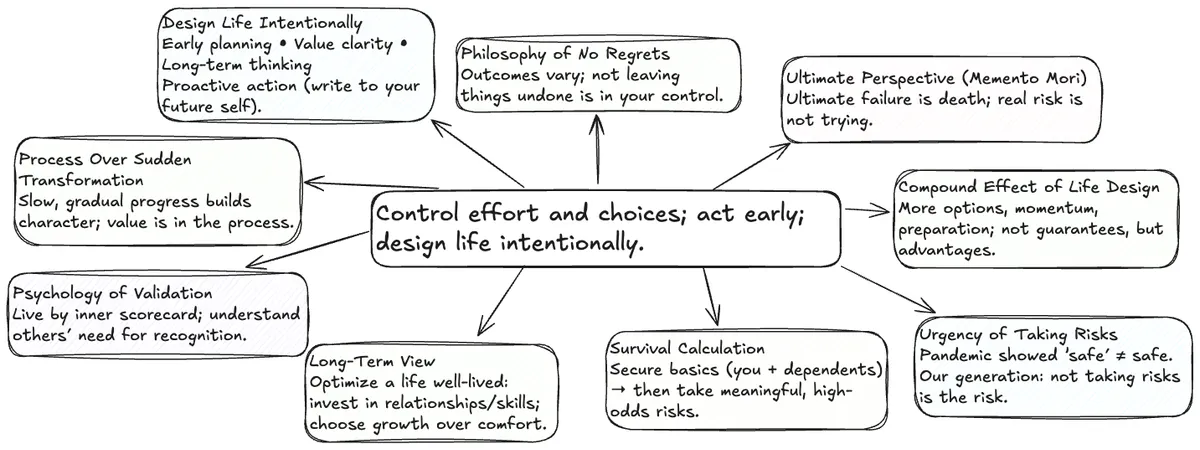
The Philosophy of No Regrets
The foundation of living without regrets lies in a simple principle: Success and failure may depend on many uncontrollable variables, but not leaving things for regrets is in your control.
This means making decisions based on what you can control - your effort, preparation, and choices - rather than outcomes you cannot guarantee.
The Ultimate Perspective
Naval Ravikant provides crucial context: “Memento Mori. Ultimate failure is assured in all human activities. Where’s the risk?”
That ultimate failure is death - we will all die. Given this certainty, why not live to our full potential? Why carry the weight of regret when we could choose action and growth by embracing each day as a finite gift?
This perspective isn’t morbid; it’s liberating. When you accept mortality, you realize that the only real risk is not trying, not growing, not becoming who you could be.
Designing Your Life Intentionally
The key to avoiding regrets is to design your life rather than simply react to circumstances. This requires:
- Early Planning: Start making intentional choices early in life when you have maximum flexibility and time for compound effects.
- Value Clarity: Understand what truly matters to you, not what others expect or what society promotes.
- Long-term Thinking: Consider how today’s decisions will affect your future self, envisioning that older version looking back with gratitude rather than longing. It’s like writing a letter to yourself decades from now, what story do you want to tell?
- Proactive Action: Take initiative on important matters rather than waiting for perfect conditions.
The Compound Effect of Life Design
When you design your life intentionally from an early age:
- You have more control over your circumstances.
- You’re less likely to be forced into situations you don’t want.
- You build momentum toward your desired outcomes.
- You create options and opportunities for yourself.
- You’re better prepared to handle unexpected challenges.
This doesn’t guarantee everything will go as planned, but it significantly increases your ability to live according to your values.
Common Sources of Regret
Relationships:
- Not telling people you love them.
- Holding grudges that serve no purpose.
- Failing to maintain important friendships.
- Not spending enough time with family.
Career and Growth:
- Not pursuing education or skills you wanted to develop.
- Staying in unfulfilling jobs too long.
- Not taking calculated risks when you had the chance.
- Failing to start that business or creative project.
Personal Development:
- Not taking care of your health when you were young.
- Avoiding difficult but critical conversations.
- Not travelling or having experiences when you could.
- Living according to others’ expectations rather than your own values.
The Urgency of Taking Risks
The universe has provided our generation with unique lessons through events like the pandemic, teaching us that certainty is an illusion and permanent jobs don’t exist. These lessons create both urgency and opportunity.
Generational Perspective:
- Previous Generation: Taking risks felt genuinely risky.
- Our Generation: Not taking risks is the actual risk, as volatility demands adaptability.
Why Risk-Taking Matters Now
The pandemic demonstrated that traditional “safe” paths (steady jobs, predictable careers) can disappear overnight. This makes calculated risk-taking not just beneficial but necessary for long-term security.
Overcoming Fear of Risk
Fear of Failure
Remember childhood games where you lost many times but kept playing. Those losses taught you resilience and strategy. Why would you avoid similar learning opportunities as an adult when the stakes and potential rewards are much higher?
Fear of Unknown Outcomes
If you don’t succeed, you’ll have valuable experience and learning that often leads to even better opportunities.
The Survival Calculation
Before taking any significant risk:
- Calculate what you need for basic survival (yours and dependents).
- Ensure you have a plan to meet those needs.
- Once survival is secured, you’re free to take meaningful risks.
- Ignore social approval and focus on the impact you want to make.
The Life You Want
Once survival is handled, forget about:
- What others will think
- Making impressions on anyone
- Proving points to anyone
- Seeking outside approval
Instead, focus on:
- The life you want to live
- The impact you want to make
- The legacy you want to leave
- The principles you want to establish
- The world you want to help create
Remember: “Too many among us die at thirty and are buried at 80.” Don’t let fear prevent you from truly living while you’re alive-take risks with favourable odds to compound your life’s value.
The Mathematics of Success
Success typically comes down to being in the top 1% of any field — UPSC, IIT-JEE, wealth creation, trading profitability. Instead of dismissing these odds, learn how to play the game safely.
The Strategy
Play “everything or something” instead of “everything or nothing.” Structure your pursuits so that:
- When you lose, you lose little.
- When you gain, you gain massive amounts.
- You acquire valuable skills regardless of the specific outcome.
The Importance of Deserving Success
Charlie Munger says that “To get what you want, you have to deserve what you want. The world is not yet a crazy enough place to reward a bunch of undeserving people”
Avoid pursuing success without building the skills to sustain it. Overnight success without underlying capability often leads to loss (like lottery winners who return to poverty). Focus on deserving what you achieve through genuine skill development.
Risk-Reward Management
Design your life like a trader designs positions — with favourable risk-reward ratios where potential gains significantly outweigh potential losses.
The Action Framework
To minimize future regrets, use this decision-making framework as compass:
- 1. Future Self Test: Will I regret not doing this when I’m 80 years old?
- 2. Control Analysis: What aspects of this situation can I control? Focus your energy there.
- 3. Value Alignment: Does this decision align with my core values and long-term vision?
- 4. Preparation Assessment: Have I done everything reasonable to prepare for success?
- 5. Learning Opportunity: Even if this doesn’t work out as planned, what will I learn?
The Reality of Change and Growth
Progress should be slow and gradual, requiring “hard work, a bit of luck, a fair amount of self-sacrifice, and a lot of patience.”
The fantasy of sudden transformation bypassing effort and time is seductive but unrealistic. Real growth comes through process, and the process itself is where the value lies.
Why the Process Matters:
- It builds the character needed to handle success.
- It teaches lessons that can’t be learned any other way.
- It makes achievements meaningful and lasting.
- It prevents imposter syndrome and insecurity
Dealing with Inevitable Setbacks
Even with the best planning, things won’t always go as expected. The key is to respond to setbacks in ways that minimize future regrets:
- Take Responsibility: Own your part in what went wrong without excessive self-blame.
- Learn Quickly: Extract lessons from failures and apply them going forward.
- Adjust Course: Use new information to refine your approach.
- Maintain Perspective: Remember that setbacks are temporary; giving up is permanent.
The Psychology of Validation
Robert Greene notes: “People’s need for validation and recognition, their need to feel important, is the best kind of weakness to exploit.”
Understanding this helps you avoid regret in two ways:
- Personal Freedom: When you recognize your own need for validation, you can choose to live by your inner scorecard rather than seeking others’ approval.
- Better Relationships: Understanding others’ need for recognition helps you build stronger relationships by acknowledging and appreciating people genuinely.
The Reading Advantage
Mark Twain observed: “If you are literate but do not read, then you have no advantage over those people who can’t read.”
Reading provides access to the wisdom of history’s greatest minds. Through books, you can have mentors you’ve never met and learn from experiences you’ve never had.
In today’s world, where attention spans are scarce, but information is abundant, the ability to read deeply becomes a significant competitive advantage.
Practical Daily Habits
Morning Reflection: Start each day by considering what would make it meaningful.
Evening Review: End each day by reflecting on whether you lived according to your values.
Weekly Planning: Regularly assess whether your activities align with your long-term goals.
Monthly Evaluation: Check whether you’re making progress on important life areas.
Annual Visioning: Set aside time each year to reassess your direction and make course corrections.
The Long-Term View
Remember that you’re optimizing for a life well-lived, not a day well-lived. This means:
- Sometimes doing difficult things that pay off later.
- Investing in relationships and skills that compound over time.
- Making sacrifices in the short term for long-term fulfilment.
- Choosing growth over comfort when it matters.
The ultimate question: When you’re at the end of your life, looking back, what will you wish you had done differently? Start doing those things now.
Living without regrets doesn’t mean living without mistakes. It means living with intention, courage, and alignment with your deepest values. It means deciding action over inaction when it matters most, using the tools from this book to design a life that could truly change how you and those around you experience the world.