 Musings with Randheer
Charlie Munger’s wisdom about avoiding stupidity rather than trying to be brilliant offers a profound approach to decision-making and life. This principle, rooted in the mathematical concept of inversion and building on the probabilistic thinking from Chapter 13—where we learned to estimate failure likelihoods—can provide remarkable long-term advantages, especially when applied to career choices (Chapter 14) and future uncertainties (Chapter 18).
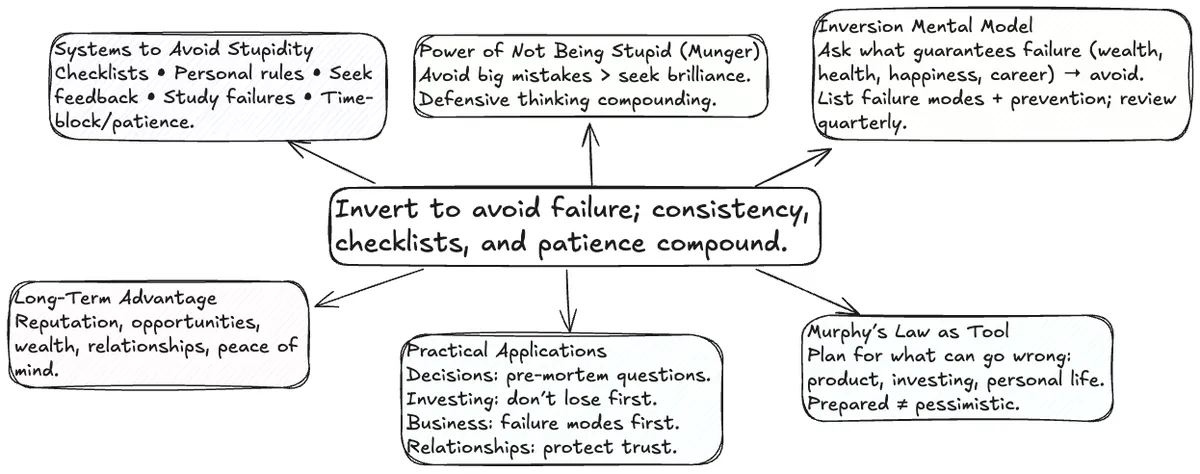
The Power of Not Being Stupid
Charlie Munger observed: “It is remarkable how much long-term advantage people like us have got by trying to be consistently not stupid, instead of trying to be intelligent.”
This approach works because:
- Avoiding big mistakes is often more valuable than making brilliant moves.
- Consistency in avoiding errors compounds over time.
- Defensive thinking prevents catastrophic failures that can wipe out years of progress.
- It’s easier to identify and avoid bad decisions than to consistently make great ones.
The Inversion Mental Model
The foundation of avoiding stupidity is inversion — thinking backward from failure to success, as Munger advocates:
Instead of asking “How can I succeed?” ask “What would guarantee failure?”
Instead of “How can I be happy?” ask “What makes people miserable?”
Instead of “How can I build wealth?” ask “What destroys wealth?”
Then systematically avoid those failure modes. To apply this practically:
- List potential failure scenarios with probabilities (e.g., chance of career stagnation if avoiding learning, per Chapter 14).
- Create prevention strategies, like habits from Chapter 4 to counter them.
- Review quarterly: What stupidities have I avoided, and how has that compounded my progress?
This ties into no-regrets living (Chapter 16) by focusing on controllable actions over uncertain outcomes.
Murphy’s Law as a Planning Tool
Murphy’s Law states: “Whatever can go wrong will go wrong.” While this sounds pessimistic, it’s actually a valuable planning framework:
- In Business: Think through every way your product launch could fail, then prepare for those scenarios.
- In Investing: Consider all the ways an investment could lose money before considering potential gains.
- In Personal Life: Plan for potential problems in important areas like health, relationships, and finances.
This isn’t about being negative — it’s about being prepared.
Common Forms of Stupidity to Avoid
Invert these common pitfalls using book themes to turn them into strengths:
Financial Stupidity:
- Spending more than you earn consistently.
- Not having an emergency fund, leaving yourself vulnerable to emergencies.
- Putting all investments in one asset or sector, ignoring diversification.
- Making investment decisions based on emotions.
- Ignoring the power of compound interest, missing long-term growth in wealth-building.
Career Stupidity:
- Staying in jobs that don’t develop your skills, falling into comfort trap and then not being up to date to required skills of market.
- Burning bridges with colleagues or employers, damaging network needed to fall on in life.
- Not investing in continuous learning, becoming obsolete amid technological change.
- Making career decisions based solely on immediate money.
- Failing to build and maintain professional relationships, limiting opportunities as a result.
Health Stupidity:
- Ignoring obvious health problems, letting it compound into larger issues.
- Consistently poor sleep habits, affecting mental and physical health.
- Sedentary lifestyle with poor nutrition, undermining the affect of diet and movement on body.
- Excessive stress without management strategies, leading to worry and anxiety.
Relationship Stupidity:
- Not communicating honestly about problems, eroding trust and integrity.
- Taking important relationships for granted, letting other person feel not important and causing emotional gap in relationship.
- Holding grudges that serve no purpose, blocking emotional growth.
- Surrounding yourself with negative or toxic people, amplifying consistent stupidity.
- Failing to invest time in meaningful relationships, leading to regrets.
The Compound Effect of Avoiding Mistakes
Just as positive actions compound over time, avoiding negative actions also compounds:
- Year 1: You avoid a few major mistakes that your peers make.
- Year 5: The gap between you and those who made mistakes becomes noticeable.
- Year 10: The compound effect creates significant advantages in wealth, health, relationships, and opportunities.
- Year 20: The difference becomes dramatic.
Practical Applications
Daily Decisions: Before making any significant decision, ask “What could go wrong?” and “How can I prevent or mitigate those problems?”
Investment Decisions: Focus first on not losing money, second on making money.
Business Decisions: Identify the ways a strategy could fail before implementing it.
Personal Relationships: Avoid behaviours that damage trust and connection.
The Naval Ravikant Perspective
Naval Ravikant adds another dimension to this thinking: “All of man’s troubles arise because he cannot sit in a room quietly by himself” (quoting Blaise Pascal).
Much stupidity comes from:
- Restlessness that leads to unnecessary action, like impulsive decision.
- Boredom that drives poor decisions.
- Social pressure that overrides good judgment.
- Impatience that prevents long-term thinking. Ignoring compound effects.
Learning to be comfortable with inaction, uncertainty, and solitude prevents many forms of stupidity
Building Systems to Avoid Stupidity
Create Checklists: For critical decisions, develop checklists of potential difficulties to consider.
Establish Rules: Create personal rules that prevent predictable mistakes (e.g., “Never make investment decisions when emotional”).
Seek Feedback: Ask trusted advisors to point out your blind spots and potential mistakes.
Study Failures: Learn from others’ mistakes rather than making them yourself. As in what not to do as a founder (from chapter 11).
Practice Patience: Many forms of stupidity result from acting too quickly. Use time-blocking method explained in chapter-17 to create space for better decision making.
The Long-Term Advantage
People who consistently avoid stupidity gain several advantages:
- Reputation: Others trust their judgment and seek their advice.
- Opportunities: They’re included in important decisions and ventures.
- Wealth: They avoid financial disasters that destroy wealth.
- Relationships: They maintain strong connections by avoiding relationship-damaging behaviours.
- Peace of Mind: They sleep well knowing they’ve avoided preventable problems
Balancing Caution with Action
Avoiding stupidity doesn’t mean avoiding all risks. It means:
- Taking calculated risks rather than foolish ones, with favourable probabilities.
- Preparing for downside scenarios before pursuing upside opportunities.
- Acting with appropriate caution rather than reckless abandon.
- Learning from small mistakes to avoid large ones.
The Wisdom of Simplicity
Often, avoiding stupidity means choosing simple, proven approaches over complex, clever ones:
- In Investing: Index funds often outperform complex strategies.
- In Business: Simple business models typically work better than complex ones.
- In Life: Basic habits (exercise, sleep, good relationships) matter more than optimization hacks.
Remember: You don’t need to be the smartest person in the room. You just need to consistently avoid being the most foolish. Over time, this approach typically leads to better outcomes than trying to be brilliant. Potentially transforming your life through steady progress.