 Musings with Randheer
Career decisions shape not just our professional lives but our entire existence. The framework you use to make these choices determines whether you build a fulfilling career or merely collect pay cheques.
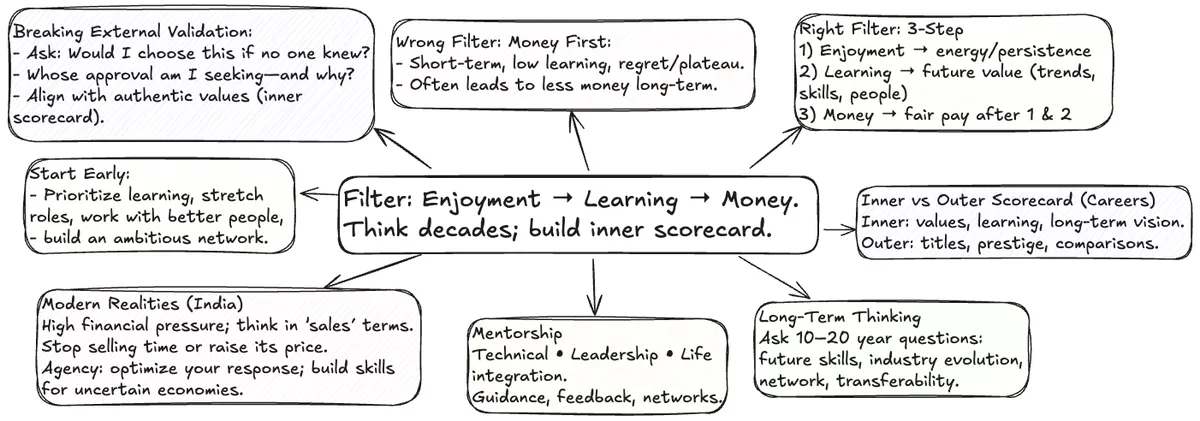
The Wrong Filter: Money First
Most people use money as their primary career filter. This approach typically leads to:
- Short-term thinking focused on immediate compensation.
- Jobs that don’t develop your long-term value.
- Work that feels meaningless or draining.
- Career paths that plateau quickly.
- Regret about opportunities missed.
While financial considerations matter, leading with money often results in less money over time because you don’t develop the skills and passion that create exceptional value.
The Right Filter: A Three-Step Framework
When evaluating career opportunities, use this hierarchy:
1. Enjoyment: Do you genuinely enjoy the work?
This isn’t about finding your “passion” but about work that energies rather than drains you. When you enjoy what you do:
- You naturally invest more effort and attention, creating momentum for growth.
- You develop skills faster because learning feels rewarding.
- You’re more likely to persist through difficulties.
- You perform at a higher level consistently, compounding into greater opportunities.
2. Learning Opportunity: Will this role increase your value?
Drawing from probabilistic thinking, estimate the likelihood this role builds skills for future success. Ask yourself:
- What new skills will I develop, and how do they align with emerging trends?
- How will this experience make me more valuable in the future?
- What challenges will push me to grow?
- What kind of people will I work with and learn from?
Growth in your capabilities is the foundation of long-term career success.
3. Money: Is the compensation fair for the value provided?
Only after confirming enjoyment and learning potential should you evaluate compensation, using the opportunity cost. At this point, you can often accept lower immediate pay because:
- The skills you develop will increase your future earning potential, compounding like an investment.
- The enjoyment makes the work sustainable long-term.
- The learning creates opportunities for advancement.
If compensation feels unfair, negotiate or walk away—but never lead only with money, as it may result in short-term gains at the expense of long-term fulfilment.
The Compound Effect of Career Choices
When you prioritize enjoyment and learning over immediate money, you create a compound effect:
- Years 1-3: You might earn less than peers who prioritized salary, but you’re developing valuable skills and building passion for your field.
- Years 4-7: Your enhanced skills and genuine expertise begin creating better opportunities and higher compensation.
- Years 8+: Your combination of skills, experience, and passion puts you in a different league, typically earning significantly more than those who prioritized early salary.
The Startup Advantage
Working at startups, especially early in your career, often provides exceptional learning opportunities:
- Diverse Challenges: Every day presents new problems requiring creative solutions.
- Rapid Learning: The fast-paced environment accelerates skill development.
- Impact Visibility: Your contributions directly affect company success.
- Skill Development: You frequently work across multiple functions, developing broad capabilities.
- Network Building: You work closely with other ambitious, talented people.
Traditional education provides minimal preparation for startup environments, making the learning curve steep but valuable.
The Inner vs. Outer Scorecard in Careers
Warren Buffett’s scorecard concept, explored in chapter 6 and 9, applies directly to career decisions:
Outer Scorecard Career Decisions:
- Choosing jobs based on what others will think.
- Prioritizing titles and company prestige over actual work, ignoring learning potential.
- Making decisions based on social expectations, that may lead to regret.
- Comparing your path to others’ paths constantly.
Inner Scorecard Career Decisions:
- Choosing work that aligns with your values and interests, building on self-awareness.
- Prioritizing learning and growth over external validation.
- Making decisions based on your long-term vision, like designing a no-regret life (Chapter 16).
- Measuring success by your own standards, focussing on integrity and impact.
Long-Term Thinking in Career Development
The most successful careers are built over decades, not years. This perspective changes how you evaluate opportunities:
- Short-term View: What will this job pay me this year?
- Long-term View: How will this experience position me for the next 10–20 years of my career?
Questions for Long-term Thinking:
- What skills will be valuable in the future?
- How is this industry likely to evolve?
- What kind of network am I building?
- Am I developing transferable skills or just job-specific knowledge?
The Role of Mentorship
Having mentors accelerates career development by:
- Providing guidance on decisions you haven’t faced before.
- Sharing insights about industry trends and opportunities.
- Offering feedback on your development and blind spots.
- Opening doors to new opportunities through their networks.
Seek mentors in three areas:
- Technical Skills: People who excel in your field.
- Leadership: Those who’ve built and managed teams.
- Life Integration: People who’ve successfully balanced career and personal fulfilment.
Practical Decision-Making Framework
When facing career decisions, integrate the mental model from chapter 13 for a structured approach:
- Clarify Your Values: What matters most to you in work and life?
- Assess the Opportunity: How does this role score on enjoyment, learning, and compensation?
- Consider Timing: Where are you in your career development? Early career should prioritize learning; later career might balance other factors.
- Evaluate the People: Who will you work with? Great colleagues accelerate your development.
- Think Long-term: How does this decision affect your 5-10 year trajectory?
The Importance of Starting Early
The earlier you apply this framework, the more powerful the compound effect becomes. If you’re early in your career:
- Prioritize learning over earning.
- Seek challenging roles that stretch your capabilities.
- Work with people who are better than you at skills you want to develop.
- Build a network of ambitious, talented people.
Avoiding Common Career Traps
The Comfort Trap: Staying in roles that are easy but don’t challenge you. This may lead to career stagnation.
The Money Trap: Taking high-paying jobs that don’t develop your capabilities, ignoring long-term compounding.
The Prestige Trap: Choosing roles based on external perception rather than actual growth
The Security Trap: Avoiding risk even when it limits your potential, such as shying away from startup opportunities despite their learning upside.
Remember: The goal isn’t to find the perfect job, but to build a career that provides both fulfilment and financial security through continuous growth and value creation.
Breaking Free from External Validation
One of the biggest obstacles to making good career decisions is the need for external validation — living according to others’ expectations rather than your own values.
The Validation Trap:
Negative motivation often comes from trying to prove points to people who think you’re not capable of something, even when you’re not genuinely interested in that thing. This creates several problems:
- You spend energy on goals that don’t align with your interests.
- You become dependent on others’ opinions for motivation.
- You lose touch with your authentic desires and values.
- You create a cycle of seeking approval that never ends.
The Inner vs. Outer Scorecard in Career Decisions
Outer Scorecard Thinking:
- Making career choices based on how they’ll look to others.
- Seeking validation from people whose opinions shouldn’t matter to your life decisions, such as distant relative or social media.
- Comparing your path to others’ paths constantly, breeding envy and unhappiness.
- Living in reaction to others’ expectations.
Inner Scorecard Thinking:
- Making decisions based on your genuine interests and values, aligning with self integrity.
- Evaluating success by your own meaningful standards, focusing on learning and enjoyment.
- Focusing on your own growth rather than others’ perceptions.
- Taking responsibility for your own life direction, designing it intentionally.
Practical Application
Before making any major career decision, ask yourself:
- Am I doing this because I genuinely want to, or because of how it will look? Consider the opportunity cost as well.
- Whose approval am I seeking, and why does their opinion matter? Invert: What if I ignored them-would my choice change?
- What would I choose if no one else would ever know about it? This will reveal your authentic desires.
- How does this align with my authentic values and interests, ensuring long term happiness?
The Stoic Perspective
A Stoic approach suggests focusing on what’s in your control (your effort, choices, and responses) rather than what others think of your decisions. This doesn’t mean being antisocial, but rather prioritizing your authentic development over social approval.
The Reality of Modern Career Challenges
In today’s economy, especially for those aged 25-35 who are primary breadwinners of their family, career decisions carry enormous weight. Living in metro cities without a 2 lakh per month income creates significant financial stress, while more than 90% of Indians earn less than Rs.25,000 per month.
The Sales Perspective
To earn money, you’re always making sales — either selling your time as an employee or selling products as an entrepreneur. The key is becoming the best salesman you can be, which often means:
- Stop selling your time (the most precious thing you have), or
- Increase the price of your time significantly
Individual Agency
While you can’t control government policies or inflation, you can control your response to circumstances. The question becomes: Given every condition you face, what’s the best you can do to navigate your life and fulfil your dreams?
This requires optimizing your life based on your personal answer to that question, rather than waiting for external conditions to improve-apply probabilistic thinking to estimate 50-70% chance of economic shift, then act by building skills that thrice in uncertainty (Chapter 18).