 Musings with Randheer
Life is inherently uncertain, yet our minds crave certainty. Building on the Stoic wisdom from Part 1—where we learned to focus on what we can control (Chapter 1) and find meaning amid uncertainty (Chapter 2)—probabilistic thinking offers a powerful framework for making better decisions in an uncertain world by embracing uncertainty rather than fighting it. This approach, combined with mental models, helps us navigate complexity more effectively, turning potential regrets into informed choices.
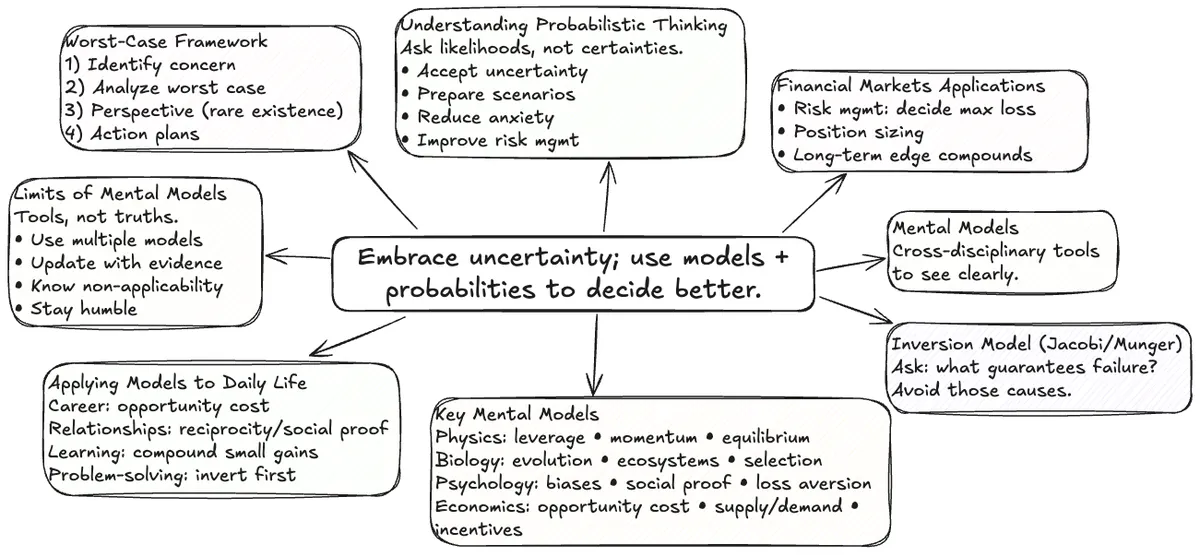
Understanding Probabilistic Thinking
Instead of asking “Will this happen?” probabilistic thinking asks “What’s the likelihood this will happen?” This shift in perspective enables better decision-making because:
- It acknowledges uncertainty as natural rather than problematic, aligning with the Stoic acceptance of what we cannot control.
- It helps you prepare for multiple scenarios.
- It reduces anxiety by accepting what you cannot control.
- It improves risk management across all areas of life.
A Practical Example
Consider the COVID-19 third wave predictions. Instead of demanding certainty about whether it would occur, probabilistic thinking allows to say: “There’s a rare ‘chance’ of a third wave, but I can prepare for it while not being paralysed by fear.”
This approach enables action despite uncertainty. You can’t control whether events occur, but you can control your preparation and response.
Applications in Financial Markets
Probabilistic thinking is essential in investing and trading:
- Risk Management: You can’t predict market movements with certainty, but you can decide how much you’re willing to lose on any trade through stop-losses.
- Position Sizing: Instead of betting everything on one outcome, you size positions based on probability and potential impact.
- Long-term Perspective: Over many trades or investments, probabilistic advantages compound into significant returns.
The key insight: “We don’t know how much upside the market can give us, but we always can decide how much loss we are willing to give to the market.”
Mental Models: Tools for Better Thinking
Mental models are frameworks that help you understand and navigate complex situations. Great thinkers like Charlie Munger advocate building a toolkit of mental models from various disciplines.
The Inversion Model
One of the most powerful mental models comes from mathematician Carl Gustav Jacobi: “Invert, always invert.”
Instead of asking “How can I succeed?” ask “What would guarantee failure?” Then avoid those things.
Examples:
- Instead of “How can I be happy?” ask “What makes people miserable?” then avoid those behaviours.
- Instead of “How can I build a successful business?” ask “What kills businesses?” then avoid those mistakes.
- Instead of “How can I be healthy?” ask “What destroys health?” then avoid those habits.
The Worst-Case Scenario Framework
Drawing from computer science, I developed a framework for handling worry and uncertainty:
- Identify the specific concern: What exactly are you worried about?
- Analyse the worst-case scenario: What’s the absolute worst that could happen?
- Put it in perspective: In probabilistic terms, you being alive is already an extraordinarily rare event. You’re floating far above any “worst case.”
- Develop action plans: What can you do to prevent or mitigate the worst case?
This framework transforms paralysing worry into productive action.
The Power of Compound Mental Models
Just as money compounds in investing, mental models compound in thinking. Each new framework you learn enhances your ability to understand complex situations.
Key Mental Models to Develop
From Physics:
- Leverage (small inputs, large outputs): Like how small habit change can lead to massive productivity gain over time.
- Momentum (objects in motion stay in motion): Once you start a positive habit, it becomes easier to maintain, as seen in overcoming procrastination (Chapter 5).
- Equilibrium (systems seek balance): In stock market, prices eventually return to fair value.
From Biology:
- Evolution (adaptation and survival): Business must adapt to changing markets or fail.
- Ecosystems (interconnected relationships): Your career choices affect your entire life network.
- Natural selection (what works survives): In Investing, successful strategies persist while poor one fail. Same with any other field.
From Psychology:
- Cognitive biases (systematic thinking errors): Like confirmation bias, which can lead to poor investment decision if not applied through Munger inversion mental model.
- Social proof (following others’ behaviour): Can lead to herd mentality in markets or careers, better avoided through independent thinking.
- Loss aversion (losses feel worse than equivalent gains): This explains why we fear risk more than we should.
From Economics:
- Opportunity cost (what you give up for what you get): Crucial for career decision-choosing one path means forgoing others.
- Supply and demand (scarcity and abundance): Applies to job market and investment, where scarcity creates value.
- Incentives (what drives behaviour): As Charlie Munger emphasizes, incentives are the hidden forces that shape actions—understand them to predict and influence outcomes.
Applying Mental Models to Daily Decisions
Career Choices: Use opportunity cost to evaluate different paths. What are you giving up by choosing this option?
Relationships: Apply reciprocity and social proof to understand relationship dynamics.
Learning: Use compound interest thinking — small, consistent efforts create massive long-term results.
Problem-Solving: Use inversion to identify what not to do, then work forward from there.
The Limits of Mental Models
Mental models are tools, not absolute truths. They help you think more clearly but can also create blind spots if applied rigidly, much like how over-reliance on certainty in chapter 3 leads to unnecessary worry.
Guidelines for Effective Use:
- Use multiple models to analyse complex situations, combining them for a fuller picture.
- Update models when new evidence emerges, staying adaptable as in technological changes.
- Recognize when models don’t apply to specific situations.
- Remain humble about the limits of any framework, avoiding the stupidity of overconfidence.
Building Your Mental Model Toolkit
Read Widely: Expose yourself to ideas from different disciplines — science, history, psychology, economics, philosophy.
Practice Application: Regularly use mental models to analyse situations in your life.
Teach Others: Explaining mental models to others deepens your understanding.
Collect Examples: Keep a journal of how different mental models apply to real situations.
Cryptocurrency as a Probabilistic Case Study
The cryptocurrency market provides an excellent case study in probabilistic thinking and risk management. When Elon Musk’s tweets could crash entire markets and single bank decisions could wipe out investments, we’re clearly in speculative territory rather than investment territory. Drawing from value investing principles in part 3, let’s apply probabilistic analysis.
Probabilistic Analysis of Crypto:
- Volatility: Extreme price swings based on social media posts and regulatory news.
- Fundamental Support: Unlike stocks, cryptocurrencies lack underlying business fundamentals to analyse, increasing uncertainty for long term prediction.
- Market Maturity: Still largely driven by speculation rather than utility.
Risk Management Perspective:
- Lottery Odds: The probability of cryptocurrency gains resembles lottery odds rather than investment returns.
- Handling Success: Studies show lottery winners often return to their previous financial situation within years, suggesting that sudden wealth without underlying skills isn’t sustainable.
Investment Principles Applied:
- Invest in Yourself First: Before speculating on volatile assets, build skills and knowledge that compound over time, with near 100% certainty of positive returns.
- Avoid Gambling: Focus on building wealth through proven methods rather than seeking quick gains.
- Control What You Can: You can’t control cryptocurrency prices, but you can control your risk if you invest/trade in crypto. So make sure that you expose as much of your money as you can afford to lose.
Charlie Munger’s Perspective
Munger called cryptocurrency development “disgusting” based on both moral and financial reasoning. While technologies evolve and opinions may change, the principle remains: avoid gambling with money you can’t afford to lose.
The Broader Lesson
Use probabilistic thinking to distinguish between investments (where you can analyse fundamentals) and speculation (where outcomes depend on unpredictable factors). Allocate your resources accordingly. Perhaps limiting speculative bets to 5-10% of your portfolio while focusing 90% on proven strategies.
The Long-Term Advantage
People who think probabilistically and use mental models consistently gain significant advantages over time:
- Better decision-making under uncertainty.
- Improved risk management, tying into avoiding stupidity (Chapter 15).
- More accurate predictions about outcomes.
- Reduced emotional decision-making, enhancing happiness.
- Greater adaptability to changing circumstances.
Remember: The goal isn’t to predict the future perfectly but to make better decisions with incomplete information. Probabilistic thinking and mental models provide the tools to do exactly that. Potentially transforming your life by turning uncertainty into opportunity.