 Musings with Randheer
In business, as in life, character ultimately determines long-term success. While shortcuts and compromises might offer temporary advantages, sustainable success is built on a foundation of strong values and consistent integrity.
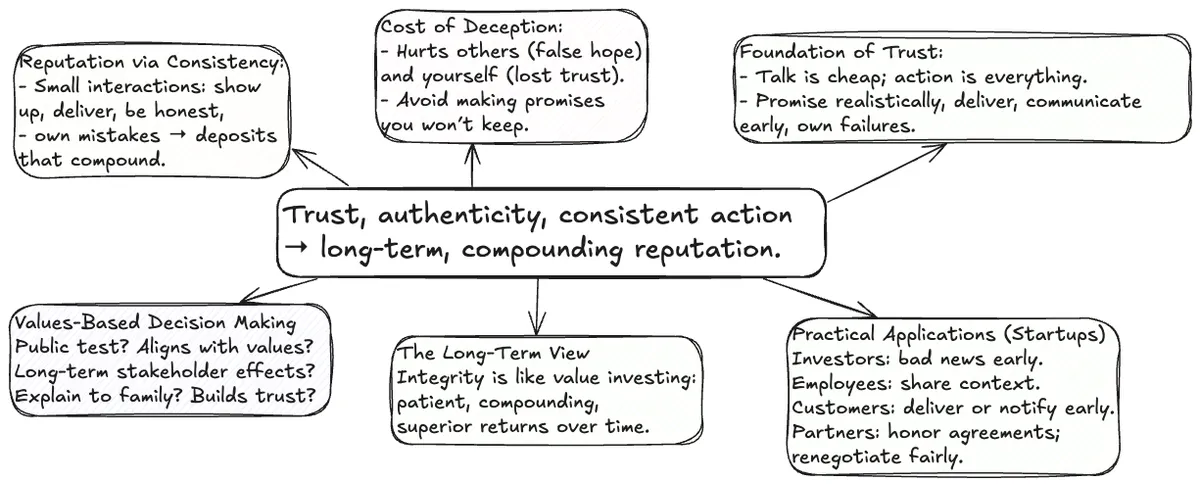
The Foundation of Trust
Trust is the currency of all business relationships. Without it, transactions become expensive, partnerships fail, and teams disintegrate. Trust is built through consistent alignment between your words and actions.
Talk is Cheap, Action is Everything: Anyone can make promises. What distinguishes reliable people is their commitment to following through. As it is often said: “Talk is cheap, anybody could do, show that in your action too.”
When you make commitments:
- Only promise what you can deliver.
- Deliver what you promise.
- If circumstances change, communicate early and honestly.
- Take responsibility for failures without making excuses.
The Charlie Munger Example
People admire Charlie Munger for his direct, unvarnished communication style. He says what he means without sugar-coating, and people respect this because they know they’re seeing the real person. There are no hidden layers or deceptive presentations.
This authenticity creates several advantages:
- People trust your word because they know you mean what you say.
- Relationships are built on solid foundations rather than false impressions.
- You don’t waste mental energy maintaining false personas.
- Decisions can be made based on reality rather than pretence.
The Cost of Deception
When you lie or give false hope, you damage multiple relationships:
You Hurt Others: The person waiting for you to fulfil a promise you never intended to keep suffers disappointment and lost opportunities.
You Hurt Yourself: Once people recognize your pattern of unreliability, they stop depending on you for important matters. This limits your opportunities and influence.
Example: Agreeing to attend an event knowing you won’t show up might seem like avoiding immediate conflict, but it causes greater harm when the person waits for you, and you don’t appear.
Building Reputation Through Consistency
Your reputation is built through thousands of small interactions, not grand gestures. Each time you:
- Arrive when you say you will.
- Deliver what you promised.
- Communicate honestly about problems.
- Take responsibility for mistakes.
You make deposits in your reputation account. These deposits compound over time, creating enormous value in both business and personal relationships.
The Inner vs. Outer Scorecard in Business
Warren Buffett’s concept of inner and outer scorecards applies directly to business ethics:
Outer Scorecard Business:
- Making decisions based on what looks good to others.
- Prioritizing short-term profits over long-term value.
- Following industry practices even when they’re wrong.
- Focusing on appearance rather than substance.
Inner Scorecard Business:
- Making decisions based on your values and principles.
- Building sustainable value for all stakeholders.
- Doing the right thing even when no one is watching.
- Focusing on substance over appearance.
Practical Applications in Startups
With Investors: Be completely honest about your progress, challenges, and prospects. Investors prefer bad news early to surprises later.
With Employees: Share appropriate information about the company’s situation. People make better decisions when they understand the context.
With Customers: Deliver what you promise. If you can’t deliver, communicate early and offer solutions.
With Partners: Honour your agreements even when circumstances change. Renegotiate fairly rather than simply breaking commitments.
The Social Responsibility of Business
As businesses grow, they gain influence and responsibility. This means considering the broader impact of your decisions:
Example: If you’re building an app and using screen time as a success metric, don’t implement features that create addiction or reduce users’ attention spans just to increase engagement.
Principle: Be socially responsible first, profitable second. Often, these goals align in the long term.
Values-Based Decision Making
When facing difficult decisions, use your values as a filter:
- What would I do if this decision were public?
- How does this align with my stated values?
- What are the long-term consequences for all stakeholders?
- Would I be comfortable explaining this decision to my family?
- Does this build or erode trust?
The Compound Effect of Integrity
Like financial investments, integrity compounds over time:
Short Term: Honest behaviour might cost you some opportunities or profits.
Long Term: Your reputation for integrity creates more and better opportunities than you could have achieved through shortcuts.
People want to work with, invest in, and buy from people they trust. This preference creates sustainable competitive advantages that can’t be easily replicated.
When Values Conflict with Profit
Sometimes doing the right thing costs money in the short term. These moments test your commitment to your values:
- Admitting mistakes even when you could hide them.
- Honoring commitments that have become unprofitable.
- Treating employees fairly during difficult times.
- Being transparent with customers about problems.
These decisions define who you are as a leader and what your business represents.
Building a Values-Driven Culture
As a leader, you set the tone for your entire organization:
- Model the Behaviour: Your actions speak louder than your policies.
- Reward Integrity: Promote and recognize people who demonstrate strong values.
- Address Violations: Deal quickly and firmly with ethical breaches.
- Communicate Clearly: Make your values explicit and explain why they matter.
The Long-Term View
Building a values-driven business is like value investing - it requires patience but generates superior long-term returns. Companies known for integrity attract better employees, more loyal customers, and more patient investors.
Remember: In the long run, character is destiny. The values you demonstrate today determine the opportunities available to you tomorrow.