 Musings with Randheer
Learning from mistakes is valuable, but learning from others’ mistakes is more efficient. Here are critical errors that can destroy startups, based on observation and experience.
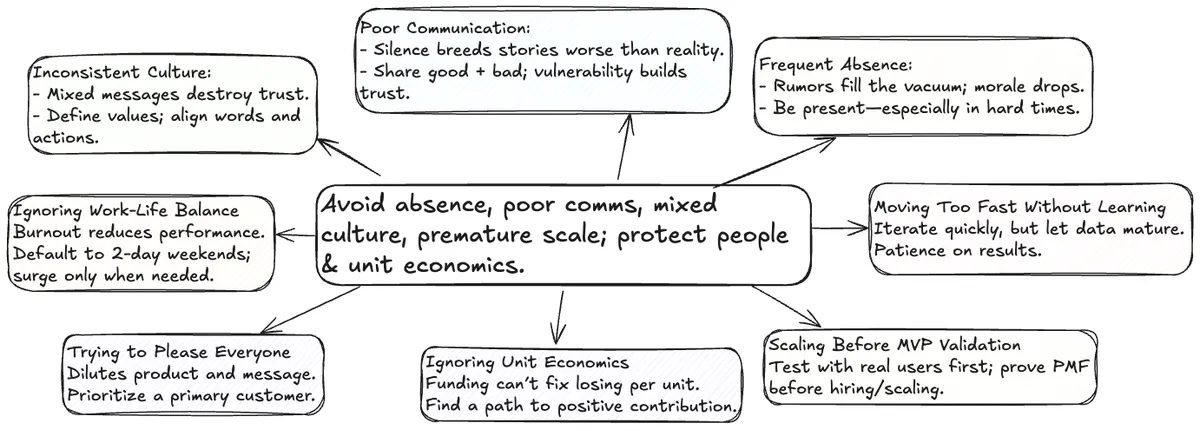
1. Frequent Absence from Your Team
Being regularly out of the office or absent creates multiple problems:
- Creates Negative Environment: When the leader is missing, rumours and gossip fill the vacuum. People speculate about the company’s future, their job security, and leadership decisions.
- Reduces Team Morale: Employees feel abandoned and unimportant when leadership isn’t present during critical periods.
- Breaks Communication: Important information doesn’t flow properly when leadership is absent.
Solution: Be present, especially during challenging times. Your physical and emotional presence matters more than you think.
2. Poor Communication with Your Team
Failing to communicate regularly and transparently is one of the fastest ways to lose your team’s trust and effectiveness.
The Problem: When you don’t communicate, people make up their own stories about what’s happening. These stories are usually worse than reality.
The Reality: Nobody expects you to be superhuman. Employees understand startups are risky and uncertain. They’re mature enough to handle difficult news.
The Solution: Share both good news and challenges. When you’re vulnerable and honest about difficulties, it builds trust and helps people feel secure by knowing what lies ahead.
Remember: Even Superman movies became less popular when they removed vulnerability from the character. People connect with humanity, not perfection.
3. Inconsistent Culture and Mixed Messages
Telling different people different things about the same situation destroys trust and makes it impossible to establish consistent culture.
The Problem: When your words don’t match your actions, or when you give conflicting information to different team members, you lose credibility completely.
The Solution:
- Establish clear values and stick to them.
- Ensure your actions align with your stated principles.
- Give consistent messages to all team members.
- Address conflicts between your values and actions immediately.
4. Moving Too Fast Without Learning
The startup mantra “move fast and break things” has been misinterpreted to mean rushing without learning.
The Problem: Trying to go so fast that you don’t give experiments enough time to generate meaningful data leads to poor decision-making.
The Reality: We overestimate what we can accomplish in short periods and underestimate what’s possible over longer periods. Many successful “startups” are actually 10–15 years old.
The Solution: Move fast on experiments and iteration, but be patient with results. Give each test enough time to produce reliable data before making major decisions.
5. Ignoring Work-Life Balance
Demanding maximum office hours and minimal time off is counterproductive and drives away good people.
The Problem: People need personal time to recharge, maintain relationships, and develop skills. When they only get one day off per week, that day gets consumed by basic life maintenance, leaving no time for renewal.
The Science: Research shows that well-rested people are more productive than exhausted people working longer hours. Continuous work without proper rest leads to burnout and decreased performance.
The Solution: Implement a two-day weekend policy as standard. People will work late nights and weekends when truly needed if they normally have reasonable schedules.
6. Scaling Before Validating Your MVP
Hiring and scaling up before properly testing your Minimum Viable Product is a costly mistake.
The Problem: You’re building infrastructure for a product that may not work, wasting time and money that could be spent on validation and improvement.
The Solution: Thoroughly test your MVP with real customers before expanding your team or operations. Make sure you have product-market fit before scaling.
7. Ignoring Unit Economics
Building a business that loses money on every transaction and hoping to make it up in volume is a recipe for failure.
The Problem: If your business model doesn’t work at small scale, it won’t work at large scale. Economies of scale can improve margins but can’t fix fundamentally unprofitable models.
The Solution: Ensure your unit economics are positive or have a clear, realistic path to profitability before scaling operations.
8. Lack of Financial Transparency
Keeping financial information secret from key team members creates uncertainty and prevents good decision-making.
The Problem: When people don’t understand the financial situation, they can’t make informed decisions about priorities, resource allocation, or their own careers.
The Solution: Share appropriate financial information with key team members. They need context to make good decisions and feel secure in their roles.
9. Trying to Please Everyone
Attempting to satisfy all stakeholders often results in satisfying none of them.
The Problem: When you try to make everyone happy, you often make compromises that weaken your product, dilute your message, and confuse your market.
The Solution: Be clear about who your primary customer is and what problem you’re solving for them. Some people won’t like your choices, and that’s okay.
10. Neglecting Your Own Development
Founders often focus entirely on their business while neglecting their own learning and growth.
The Problem: As your company grows, you need to grow as a leader. The skills that got you started won’t be sufficient to scale the business.
The Solution: Invest in your own development through reading, mentorship, and learning from other successful founders. Your growth directly impacts your company’s potential.
Remember: “No action is also an action.” Avoiding these mistakes is as important as taking positive actions. Prevention is often easier than correction.