 Musings with Randheer
The wisdom of legendary investors offers invaluable insights that extend far beyond financial markets. These principles apply to business, life decisions, and character development.
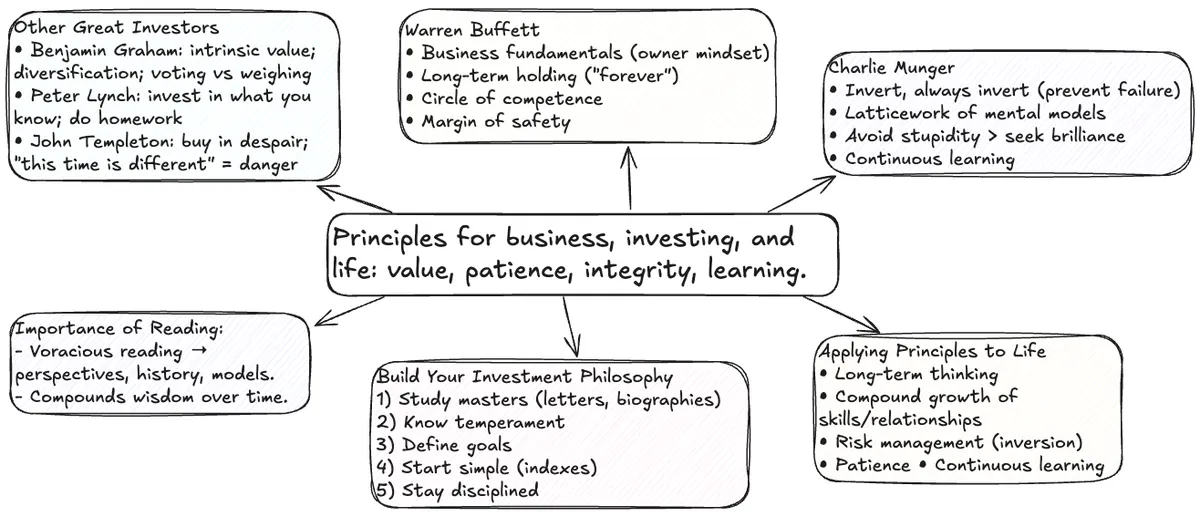
Warren Buffett: The Oracle of Omaha
Buffet’s investment success stems from simple principles consistently applied over decades:
Focus on Business Fundamentals: When you buy a stock, you’re buying a piece of a business. Understand what the company does, how it makes money, and what gives it a competitive advantage. For instance, Buffett’s purchase of Coca-Cola in 1988 was based on its timeless brand and global distribution, not short-term trends.
Long-Term Thinking: Buffet says that “Our favourite holding period is forever.” This perspective eliminates the noise of short-term price movements and focuses on long-term business value.
Circle of Competence: Invest only in businesses you understand. Buffet avoided technology stocks for years because he didn’t understand them well enough.
Margin of Safety: Buy stocks when they’re trading significantly below their intrinsic value. This provides protection against errors in judgment or unforeseen circumstances.
Charlie Munger: The Multidisciplinary Thinker
Munger, Buffet’s longtime partner, contributes equally valuable wisdom, drawing from diverse fields to create “latticework of mental models”:
- Invert, Always Invert: Think about what could go wrong and work backward. Instead of asking “How can I succeed?” ask “What would guarantee failure?” then avoid those things. For example: This extends Chapter 8’s risk management by emphasizing prevention over prediction—in investing, it means scrutinizing why a company might fail before buying.
- Mental Models: Develop a toolkit of mental models from various disciplines — psychology, physics, mathematics, history — to better understand complex situations.
- Avoid Stupidity: Buffet says that “It is remarkable how much long-term advantage people like us have got by trying to be consistently not stupid, instead of trying to be intelligent.”
- Continuous Learning: Munger reads constantly and believes learning should never stop. He often says, “Go to bed smarter than when you woke up.”
The Power of Integrity
Both Buffet and Munger emphasize character over cleverness. They’ve built their success on:
- Honesty: Always tell the truth, even when it’s uncomfortable. This builds trust and eliminates the mental burden of maintaining lies.
- Reliability: Do what you say you’ll do. Your word should be your bond.
- Fairness: Treat all stakeholders — shareholders, employees, customers — with fairness and respect.
- Humility: Admit mistakes quickly and learn from them rather than defending poor decisions.
Value Investing Philosophy
The core principles that guide great value investors:
- Price vs. Value: Buffet says: “Price is what you pay; value is what you get”. These two things can diverge significantly in the short term.
- Quality Businesses: Look for companies with:
- Strong competitive advantages (moats).
- Predictable cash flows.
- Competent management.
- Growing markets.
- Patience: Great investments often take years to pay off. The stock market is a voting machine in the short run but a weighing machine in the long run.
- Contrarian Thinking: Be greedy when others are fearful and fearful when others are greedy. The best opportunities frequently arise when everyone else is pessimistic.
Lessons from Other Great Investors
Benjamin Graham (The Father of Value Investing):
- “In the short run, the market is a voting machine, but in the long run, it is a weighing machine”.
- Focus on buying stocks below their intrinsic value.
- Diversification is protection against ignorance.
Graham’s influence on Buffet shows in early investments like GEICO, where he bought undervalued shares and held through volatility, demonstrating how safety margins protect against market whims.
Peter Lynch:
- “Invest in what you know”.
- “The stock market is filled with individuals who know the price of everything, but the value of nothing”.
- Do your homework before investing in any company.
Lynch’s success with Fidelity Magellan Fund came from everyday observations—like noticing successful retail chains before Wall Street did—tying into Chapter 8’s call for continuous learning.
John Templeton:
- “Buy when others are despondently selling and sell when others are greedily buying”.
- “The four most dangerous words in investing are: ‘This time it’s different’”.
Templeton’s global approach, investing in post-war Japan when others fled, highlights contrarian thinking’s rewards, much like the resilience in Part 2.
Applying Investment Principles to Life
These investment principles extend beyond financial markets:
- Long-Term Thinking: Whether building a career, relationships, or skills, think in decades rather than months.
- Compound Growth: Small, consistent improvements compound over time into remarkable results.
- Risk Management: Always consider what could go wrong and prepare accordingly.
- Patience: Good things take time. Rushing often leads to poor decisions.
- Continuous Learning: The world changes constantly. Stay curious and keep learning.
The Importance of Reading
All great investors are voracious readers. Buffett reads 500+ pages daily. Munger says he’s never met a wise person who didn’t read constantly.
Reading provides:
- Exposure to different perspectives, helping avoiding echo chambers.
- Historical context for current events.
- Mental models for decision-making.
- Compound learning over time, creating wisdom that compounds like investment.
Recommended starts: “Poor Charlie’s Almanack” for multidisciplinary thinking.
Building Your Investment Philosophy
Develop your own investment approach by:
- Studying the Masters: Read books by and about great investors. Start with Buffet’s annual shareholder letter for practical insights.
- Understanding Your Temperament: Are you naturally patient or impulsive? Conservative or aggressive? Match your style to strategies, like Lynch’s “invest in what you know” style.
- Defining Your Goals: What are you trying to achieve with your investments? Align with chapter 8’s life design framework.
- Starting Simple: Begin with broad market index funds while learning.
- Staying Disciplined: Stick to your principles even when markets are volatile. Use Graham’s margin of safety to weather storms.
The Character Connection
The most successful investors share certain character traits:
- Patience and discipline in waiting for opportunities.
- Intellectual honesty.
- Continuous learning through voracious reading.
- Long-term thinking that ignores short term noise.
- Emotional stability during market turmoil.
These same traits contribute to success in any field. The lessons of great investors are really lessons about how to think clearly and act wisely in an uncertain world.