 Musings with Randheer
Financial awareness is perhaps the most important skill not taught in schools. It’s the foundation for building wealth, achieving independence, and creating options in life. Yet most people spend more time planning their holiday than planning their financial future. In this extended exploration, I’ll equip you with a step-by-step plan to transform your financial life, potentially creating the freedom for the purposeful living in later chapters.
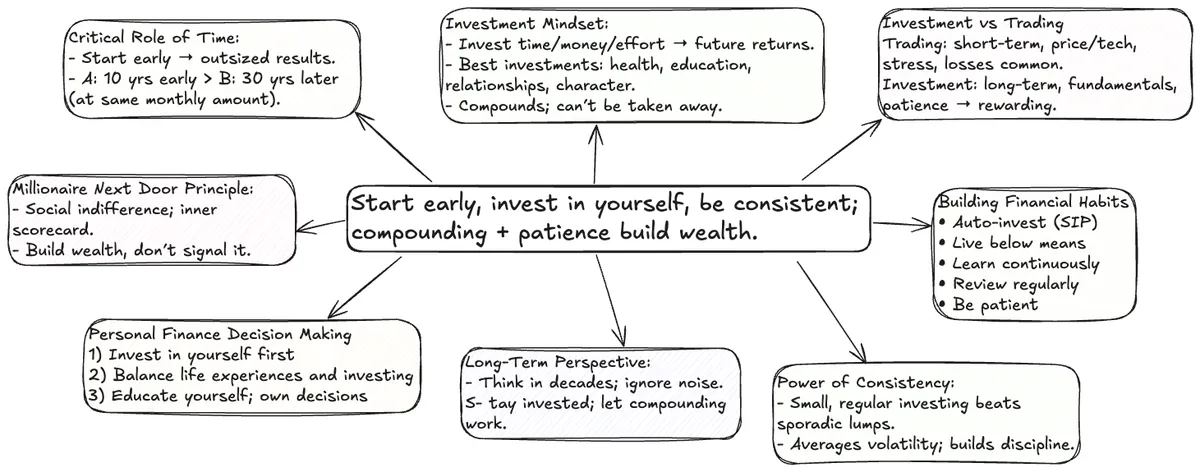
The Investment Mindset
Investment means spending your assets — time, money, and effort — in hope of greater future returns. However, when people hear “investment,” they immediately think of stocks and mutual funds, often ignoring the most significant investment: themselves.
The best investments you can make include:
- Health: Regular exercise, proper nutrition, preventive healthcare.
- Education: Books, courses, skills that increase your earning potential.
- Relationships: Building a network of meaningful connections.
- Character: Developing integrity, reliability, and wisdom.
These self-investments compound over time and can never be taken away from you.
The Critical Role of Time
Time is the most crucial factor in wealth building. Even modest amounts invested early can grow into substantial sums due to compound growth. This is why financial education should begin as early as possible.
Consider two scenarios:
- Person A invests Rs.5,000 monthly from age 25 to 35 (10 years), then stops.
- Person B invests Rs.5,000 monthly from age 35 to 65 (30 years).
Assuming 12% annual returns (like Nifty 50 averages), Person A (who invested for only 10 years) will have more money at retirement than Person B (who invested for 30 years). This demonstrates the power of starting early.
Understanding Inflation
Money sitting idle in bank accounts or at home loses value over time due to inflation. If inflation runs at 6% annually and your savings account pays 3%, you’re effectively losing 3% of purchasing power each year.
This is why participation in growth assets like stocks becomes necessary, not optional, for long-term wealth preservation.
The Indian Financial Landscape
India’s low market participation (in stocks and mutual funds) represents both a problem and an opportunity:
The Problem: Most Indians miss out on wealth creation opportunities and see their savings eroded by inflation.
The Opportunity: As financial literacy improves, there’s enormous potential for market growth and individual wealth creation.
Investment vs. Trading: A Crucial Distinction
Many people confuse investment with trading, leading to poor financial decisions:
Trading:
- Short-term buying and selling (usually within a year).
- Based on price movements and technical analysis.
- Higher risk, higher stress, requires constant attention.
- Often leads to losses for individual investors.
Investment:
- Long-term ownership (typically years or decades).
- Based on fundamental business analysis.
- Lower risk over time, less stressful, requires patience.
- Historically rewarding for disciplined investors.
Building Financial Habits
Wealth building requires developing specific habits:
- Automatic Investing: Set up systematic investment plans, so money is invested before you can spend it.
- Living Below Your Means: Spend less than you earn, regardless of income level.
- Continuous Learning: Stay informed about financial markets and investment principles.
- Regular Review: Monitor your investments and adjust as circumstances change.
- Patience: Resist the urge to make frequent changes based on short-term market movements.
The Millionaire Next Door Principle
Research shows that most wealthy people don’t look wealthy. They practice “social indifference” — not letting their spending be influenced by what others do.
This connects to Warren Buffett’s concept of the “inner scorecard” — judging yourself by your own standards rather than external appearances. When you focus on building actual wealth rather than looking wealthy, you make better financial decisions.
Starting Your Financial Journey
If you’re new to investing, follow these steps:
- Emergency Fund: Save 6–12 months of expenses in a liquid account.
- Debt Management: Pay off high-interest debt before investing.
- Education: Read books, take courses, understand basic concepts.
- Start Simple: Begin with index funds or systematic investment plans.
- Increase Gradually: Raise your investment amount as your income grows.
The Power of Consistency
Small, consistent investments often outperform large, sporadic ones. Someone investing Rs.1,000 monthly for 30 years will likely accumulate more wealth than someone making occasional large investments.
This is because:
- Consistency removes emotion from investment decisions.
- Regular investing averages out market volatility.
- It builds discipline and good financial habits.
- It ensures you don’t miss the best market days.
Long-Term Perspective
Wealth building is a marathon, not a sprint. The most successful investors think in decades, not months or years. This long-term view helps you:
- Ignore short-term market noise.
- Stay invested during difficult periods.
- Allow compound growth to work effectively.
- Make rational rather than emotional decisions.
Remember: the goal isn’t to get rich quickly but to build sustainable wealth that provides security and options throughout your life.
Personal Finance Decision-Making
When someone asks “Which mutual fund should I invest in?” the answer depends entirely on how you want to design your life.
The Framework for Financial Decisions:
- First Priority - Invest in Yourself:
Before any external investment, focus on developing skills that can double your salary within a year — that’s a 100%+ return, far better than any mutual fund. - Second Priority - Life Experiences:
If you’re young and postponing travel or experiences to invest money for 10-20% annual returns, you might be making a mistake. Travel and experiences in your 20s broaden your perspective, increase awareness, and help you grow professionally in ways that compound far beyond financial returns. - Third Priority - Find the Sweet Spot:
Given the power of compound interest, find a balance that allows both investing and living. Start investing early, but don’t sacrifice formative experiences. - The Education Approach:
Instead of asking others which fund to choose, educate yourself. We live in an age of democratized education — you can learn about finance, investing, and money management for free online. Take responsibility for understanding your own financial decisions.
Key Questions to Ask Yourself:
- How do I want to design my life?
- What experiences will help me grow most at this stage?
- What skills can provide the highest returns on investment?
- How can I balance present enjoyment with future security?
Remember: Nobody knows better than you how you want to design your life, so nobody else can make optimal financial decisions for you.
The Power of Compound Calculations
Understanding compound interest through practical examples can motivate better financial decisions:
Example 1 — Your Retirement (40 years at 18% return):
- One-time investment: Rs.50,000.
- Time period: 40 years.
- Number of doublings: 10.
- Final amount: Rs.50,000 × 2^10 = Rs.5 crores.
Example 2 — Seed Fund for child (24 years at 18% return):
- One-time investment: Rs.100,000.
- Time period: 24 years.
- Number of doublings: 6.
- Final amount: Rs.100,000 × 2^6 = Rs.64 lakh.
These calculations demonstrate why starting early matters enormously, even with modest amounts. The key variables are the, rate of return, and consistency.