 Musings with Randheer
Value investing is both an investment philosophy and a way of thinking about business and life. At its core, it’s about finding assets trading for less than their intrinsic worth — buying a dollar for sixty cents.
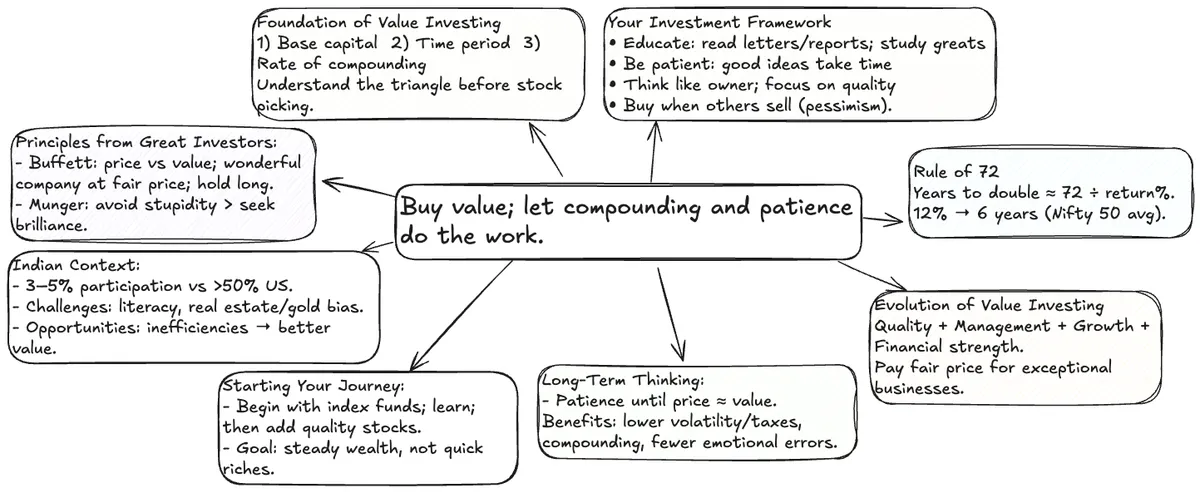
The Foundation of Value Investing
Value investing rests on three fundamental components:
- Base Capital: The initial amount you invest.
- Time Period: How long you remain invested.
- Rate of Compounding: The annual return on your investment.
Mastering compound growth
These three elements work together through the magic of compound growth. Understanding their interaction is crucial for building long-term wealth.
The Rule of 72
This simple formula helps you understand compound growth: divide 72 by your annual return rate to find how many years it takes your money to double.
For example, if you achieve a 12% annual return (the historical average of India’s Nifty 50), your money doubles every 6 years (72 ÷ 12 = 6).
A Practical Example
Consider investing Rs.10,000 at age 25, leaving it untouched until age 75 (50 years), earning 12% annually:
- Time invested: 50 years.
- Number of doubling periods: 50 ÷ 6 = 8.33 (approximately 8).
- Final amount: Rs.10,000 × 2^8 = Rs.25,60,000.
If you increase your return to 15% annually:
- Doubling period: 72 ÷ 15 = 4.8 years.
- Number of doublings in 50 years: 10.
- Final amount: Rs.10,000 × 2^10 = Rs.1,02,40,000.
This demonstrates why even small improvements in return rates create enormous long-term differences.
Quick Exercise: Use the Rule of 72 on your own savings—pick an amount, rate (e.g., 10-15%), and time horizon. Calculate doublings: What small change (like starting earlier) could 10x your outcome? This demonstrates why even small improvements in return rates create enormous long-term differences.
The Evolution of Value Investing
Traditional value investing focused primarily on buying stocks at significant discounts to their calculated intrinsic value. However, the approach has evolved to emphasize:
- Quality of Business: Companies with sustainable competitive advantages.
- Management Quality: Honest, capable leadership teams.
- Growth Prospects: Businesses with expanding opportunities.
- Financial Strength: Companies with solid balance sheets.
Modern value investors still seek discounts but are willing to pay fair prices for exceptional businesses.
Key Principles from Great Investors
Warren Buffett’s Wisdom:
- “Price is what you pay; value is what you get”.
- “It’s far better to buy a wonderful company at a fair price than a fair company at a wonderful price”.
- “Our favourite holding period is forever”.
Charlie Munger’s Insights:
- “It is remarkable how much long-term advantage people like us have got by trying to be consistently not stupid, instead of trying to be intelligent”.
- Focus on avoiding major mistakes rather than making brilliant moves.
The Importance of Long-Term Thinking
Value investing requires patience. Stock prices can remain disconnected from intrinsic value for extended periods. However, over time, price tends to converge with value.
This long-term perspective offers several advantages:
- Reduces the impact of market volatility.
- Allows compound growth to work its magic.
- Minimizes transaction costs and taxes.
- Reduces emotional decision-making.
Building Your Investment Framework
To implement value investing principles:
- Educate Yourself: Study great investors, read annual reports, understand basic financial concepts.
- Develop Patience: Accept that good investments take time to pay off.
- Think Like a Business Owner: When you buy a stock, you’re buying a piece of a business.
- Focus on Quality: Look for companies with strong competitive positions.
- Buy When Others Are Selling: The best opportunities often arise during market pessimism.
The Indian Context
In India, only about 3-5% of the population participates in the stock market, compared to over 50% in the United States. This creates both challenges and opportunities:
Challenges: Lower financial literacy, cultural preference for real estate and gold.
Opportunities: Less efficient markets may offer better value opportunities.
Starting Your Journey
Begin with index funds to gain market exposure while learning about individual companies. As your knowledge grows, you can gradually shift toward individual stock selection.
Remember: the goal isn’t to get rich quickly but to build wealth steadily over time. Value investing rewards patience, discipline, and continuous learning.