 Musings with Randheer
Self-improvement isn’t about becoming a different person. It’s about becoming the best version of who you already are. This journey requires both internal work and external action, guided by principles that have stood the test of time.
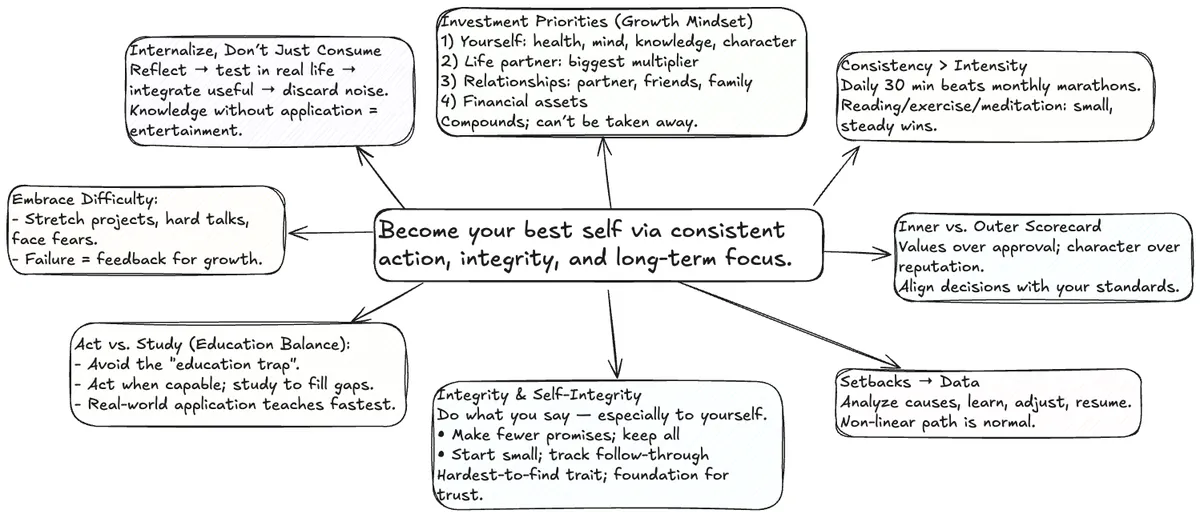
The Foundation: Investing in Yourself
The best investment you can make isn’t in stocks, real estate, or any external asset — it’s in yourself. This investment includes:
- Physical Health: Regular exercise, proper nutrition, adequate sleep.
- Mental Health: Meditation, journaling, stress management.
- Knowledge: Reading, learning new skills, staying curious.
- Relationships: Building meaningful connections with others.
- Character: Developing integrity, empathy, and wisdom.
Unlike external investments, self-investment can never be taken away from you. It compounds over time and pays dividends in every area of life. Psychologist Carol Dweck’s “growth mindset” research shows that viewing abilities as developable (rather than fixed) accelerates this process.
The Power of Consistency
One of the most important concepts I’ve learned is that consistency beats intensity. Someone who reads for 30 minutes daily will vastly outperform someone who reads for 8 hours once a month. The daily reader will complete roughly 50 books per year, while the monthly reader might finish only 3-4. For instance, Warren Buffett attributes much of his success to consistent daily reading and reflection.
This principle applies to every area of improvement:
- Daily exercise beats weekend warrior workouts.
- Regular meditation beats occasional retreats.
- Consistent learning beats cramming sessions.
Internalizing vs. Consuming
There’s a crucial difference between knowing something and internalizing it. Many people move from one self-help book or motivational video to another, seeking the temporary high of inspiration without making real changes.
True growth comes from:
- Taking time to reflect on what you learn.
- Testing ideas in real-life situations.
- Integrating useful concepts into your daily behaviour.
- Discarding what doesn’t serve you.
Knowledge without application is merely entertainment.
The Inner vs. Outer Scorecard
Warren Buffett’s concept of the inner versus outer scorecard is crucial for authentic self-improvement:
- Outer Scorecard: Living for others’ approval, comparing yourself to others, making decisions based on what looks good externally.
- Inner Scorecard: Evaluating yourself by your own standards, focusing on character over reputation, making decisions based on your values.
People who focus on the inner scorecard are less susceptible to social pressure and more likely to make decisions aligned with their long-term well-being.
The Role of Difficulty
Growth requires discomfort. As the saying goes, “If it doesn’t challenge you, it doesn’t change you.” This means:
- Seeking out difficult conversations.
- Taking on projects that stretch your abilities.
- Facing your fears rather than avoiding them.
- Embracing failure as a learning opportunity.
The goal isn’t to seek suffering for its own sake, but to understand that meaningful growth often requires moving through discomfort.
Cultivating Self-Awareness and Resilience
Self-improvement is impossible without self-awareness. This requires following checklist:
- Regular Reflection: Set aside time daily or weekly to examine your thoughts, actions, and results.
- Feedback Seeking: Ask trusted friends, mentors, or colleagues for honest feedback about your blind spots.
- Mindfulness Practice: Develop the ability to observe your thoughts and emotions without being controlled by them.
- Journaling: Write regularly to process experiences and track patterns in your thinking and behaviour.
The Compound Effect of Small Changes
Small improvements compound over time into remarkable transformations. If you improve by just 1% each day, you’ll be 37 times better after one year. This mathematical reality explains why consistency matters more than dramatic gestures.
Focus on small, sustainable changes rather than trying to overhaul your entire life at once. Build one habit at a time, master it, then add another.
Dealing with Setbacks
Self-improvement isn’t linear. You’ll have bad days, broken streaks, and periods where you feel like you’re moving backward. This is normal and expected.
The key is to treat setbacks as data, not defeats:
- What circumstances led to the setback?
- What can you learn from the experience?
- How can you adjust your approach to prevent similar issues?
- How quickly can you get back on track?
The Long-Term Perspective
Real self-improvement is measured in years and decades, not days and weeks. This long-term view helps you:
- Stay patient during slow periods.
- Maintain consistency when results aren’t immediately visible.
- Make decisions based on long-term benefit rather than short-term comfort.
- Understand that becoming your best self is a lifelong journey.
Remember: you’re not trying to become perfect; you’re trying to become better. Each day offers a new opportunity to move in the right direction.
Education vs. Action: Finding the Right Balance
One of the most critical decisions in personal development is knowing when to stop preparing and start doing. Many people get trapped in perpetual education — earning degree after degree while avoiding real-world application.
The Education Trap
Society supports endless education because it’s socially approved, but it can become a comfortable way to avoid taking risks. You can spend years earning master’s degrees and PhDs while your peers are building real-world experience and skills.
Examples from Successful People:
- Google Founders: Started their PhD programs, but immediately jumped into action when they saw practical applications for their research.
- Elon Musk: Dropped out of his physics PhD after one day to pursue entrepreneurship.
- Bill Gates: Left undergraduate studies to build Microsoft.
- Steve Jobs: Didn’t prioritize formal college education.
- Warren Buffett: Chose his university specifically to study under Ben Graham, focusing on practical application rather than just credentials.
- Mukesh Ambani: Left his foreign university studies to help his father when he felt ready to contribute.
The Key Principle
These successful individuals didn’t avoid education — they pursued learning that directly supported their goals and took action when they felt capable, rather than hiding behind academic credentials.
When to Act vs. Study:
- If you feel capable of doing something meaningful, start doing it instead of collecting more degrees.
- Use education strategically to fill specific knowledge gaps, not as a general delay tactic.
- Focus on self-education based on what you need to know for your goals.
- Remember that practical application often teaches more than theoretical study.
Note: This doesn’t mean avoiding all formal education. If you genuinely need specific knowledge or credentials for your goals, pursue them. But don’t use education as an excuse to avoid taking meaningful action.
The Importance of Life Partners
Warren Buffett emphasizes: “The most important person by far is your spouse. I can’t overemphasize how important that is.” In his 2009 shareholder letter, he writes: “Marry the right person. I’m serious about that. It will make more difference in your life. It will change your aspirations, all kinds of things.”
Data from “The Millionaire Next Door” shows that more than 80% of millionaires said “having a supportive spouse was one of the key factors in their economic success.”
Investment Priority Framework:
- Best investment: Yourself — your health, education, skills, character.
- Second-best investment: Finding and choosing the right life partner.
- Third-best investment: Building relationships — with your partner, friends, family.
- Fourth: Financial investments in stocks, real estate, etc.
Your life partner affects every aspect of your existence, not just financial success. This relationship requires lifelong investment and attention, similar to investing in yourself.
The Role of Integrity in Self-Improvement
Integrity means “being honest and truthful with others, doing what you say you’re going to do, and generally acting in a manner that is beyond reproach.”
Internal Integrity
Most importantly, integrity starts with yourself. When you tell yourself you’ll wake up at a certain time, exercise, or learn a skill, following through tests your integrity toward yourself.
Why This Matters:
- If you can’t be reliable to yourself, you can’t be reliable to others.
- Self-integrity builds the foundation for all other relationships.
- It creates the discipline necessary for achieving your goals.
- It prevents the cycle of making and breaking promises to yourself.
Building Self-Integrity:
- Make fewer commitments to yourself, but keep all of them.
- Start with small, achievable promises.
- Track your follow-through honestly.
- Treat promises to yourself as seriously as promises to others.
Warren Buffett looks for three qualities when hiring: integrity, intelligence, and energy. He notes that integrity is the hardest to find, making it your most valuable differentiator.