 Musings with Randheer
Productivity isn’t about working harder or longer — it’s about building systems that naturally lead to effective action. The foundation of all productivity lies in health and habits, two interconnected elements that determine everything else we accomplish.
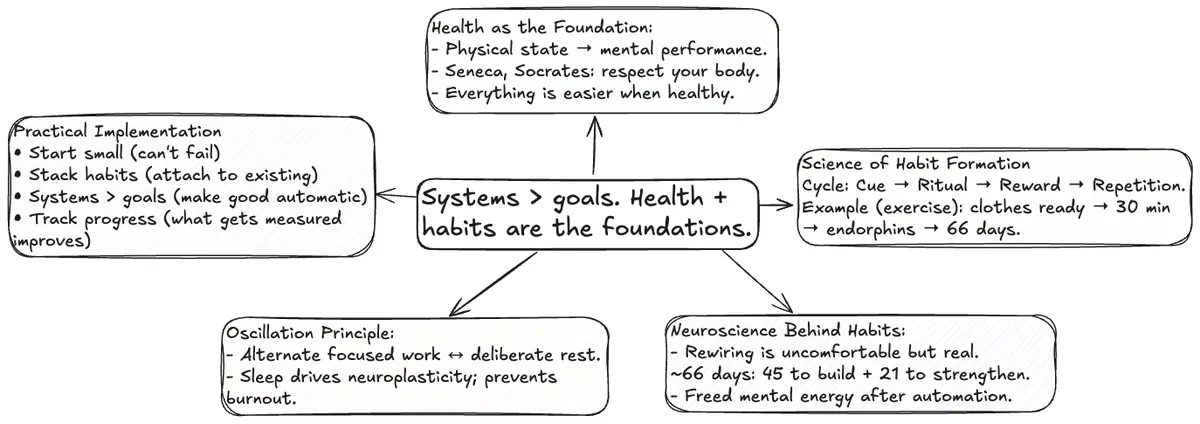
Having explored inner wisdom in Part 1—through Stoic resilience (Chapter 1), purposeful meaning (Chapter 2), and worry-free mindset (Chapter 3)—we now turn to building the habits that turn philosophy into reality. Productivity isn’t just about working harder or longer; it’s about systems that foster effective action. At its core, this begins with health and habits, the interconnected foundations of all achievement.
Health as the Foundation
Seneca wisely noted: “Health is the soul that animates all the enjoyments of life, which fade and are tasteless without it.” Socrates went further, suggesting it’s shameful to grow old without discovering what your body is capable of achieving.
Your physical state directly impacts your mental performance. When you’re healthy, everything else becomes easier. When you’re not, even simple tasks become burdensome. This makes health not just important but foundational to all other goals.
The Science of Habit Formation
Modern research echoes ancient wisdom: habits shape our lives more than conscious decisions. Every habit follows a four-step cycle:
- Cue: The trigger that initiates the behaviour.
- Ritual: The behaviour itself.
- Reward: The benefit you gain from the behaviour.
- Repetition: Performing this cycle consistently to wire it in.
For example, if you want to build an exercise habit:
- Cue: Set out workout clothes the night before.
- Ritual: Exercise for 30 minutes after waking.
- Reward: The endorphin rush and sense of accomplishment.
- Repetition: Do this daily for 66 days to establish the habit.
The Neuroscience Behind Habits
When forming new habits, you’re literally rewiring your brain. Neurons that fire together wire together, but this process requires conscious effort initially. You’re essentially pulling out old neural pathways and creating new ones - a process that can be uncomfortable.
Research suggests it takes approximately 66 days to form a new habit: 45 days to establish new neural pathways, plus 21 additional days to strengthen them until the behaviour becomes automatic. Once established, the mental energy previously required for conscious effort becomes available for other activities.
The Power of Morning Routines
As stoicism teaches us to control what we can, your morning routine sets the day’s tone, aligning actions with purpose. An effective morning routine includes:
- Exercise: Enough to make you sweat, boosting testosterone and serotonin while regulating cortisol.
- Reflection: Planning the day ahead and reviewing priorities.
- Learning: Reading or studying something that contributes to your growth.
- Meditation: Even 10 minutes can significantly improve focus and emotional regulation.
This isn’t about perfection — it’s about consistency. A simple routine followed daily outperforms an elaborate routine followed sporadically.
The Oscillation Principle
Productivity requires alternating between focused work and deliberate rest. Just as muscles grow during recovery periods, not during workouts, your brain consolidates learning and creativity during rest.
Neuroplasticity — your brain’s ability to create new connections — occurs primarily during sleep. This means adequate rest isn’t just nice to have; it’s essential for growth and performance. Continuous work without proper rest leads to burnout and decreased productivity.
Practical Implementation
Start Small: Begin with habits so easy you can’t fail. Want to read more? Start with one page per day. Want to exercise? Start with five push-ups. Success builds momentum.
Stack Habits: Link new habits to existing ones. After I pour my morning coffee (existing habit), I will write in my journal for five minutes (new habit).
Focus on Systems, Not Goals: Don’t rely on motivation or willpower. Build systems that make good behaviour automatic and bad behaviour difficult.
Track Progress: What gets measured gets managed. Keep a simple record of your habit completion to maintain accountability.
The Compound Effect
Small, consistent actions compound over time into remarkable results. Someone who reads 30 minutes daily will read roughly 50 books per year. Someone who exercises 30 minutes daily will be in exceptional shape within a year. The key is consistency over intensity.
Remember: you don’t rise to the level of your goals; you fall to the level of your systems. Build systems that support the person you want to become, and the results will follow naturally.