 Musings with Randheer
Worry is perhaps the most useless emotion we experience, yet it consumes enormous amounts of our mental energy. Through both philosophical study and practical experience, I’ve developed a framework for minimizing worry and maximizing peace of mind.
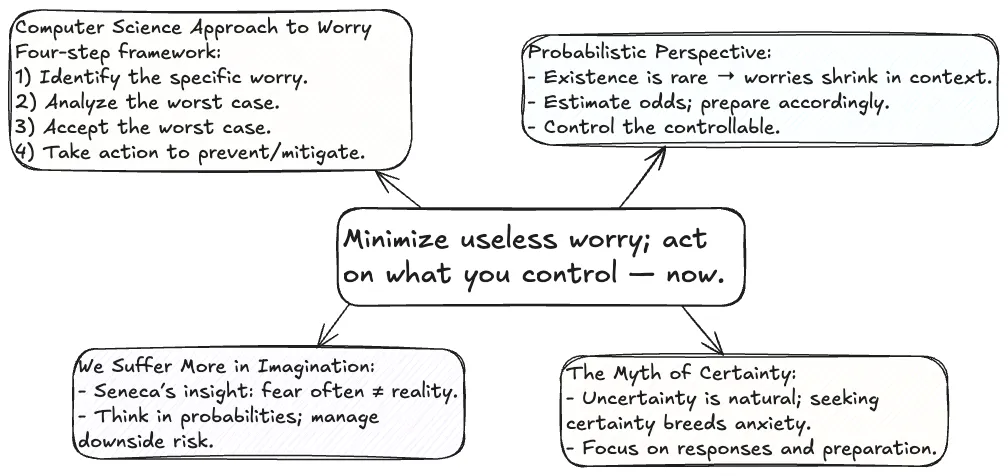
The Computer Science Approach to Worry
Through philosophical study and personal experience, I have developed one of the most valuable mental models that comes from computer science: thinking about worst-case scenarios. In programming, we must solve problems considering the worst-case conditions. But in life, we have an advantage - if we can’t solve a problem after genuine effort, we can often start over.
Here’s my four-step framework for eliminating worry:
- Identify the specific worry: What exactly are you worried about? Get precise.
- Analyze the worst-case scenario: What’s the absolute worst that could happen if your fear comes true? Think through it completely.
- Accept the worst case: Commit to accepting whatever might happen. Most of the time, you’ll realize it won’t kill you or permanently ruin your character unless you let it.
- Take action: Do whatever you can to prevent the worst case, then get busy with productive work. Action eliminates worry.
The Probabilistic Perspective
From a probabilistic standpoint-as we touched on in chapter 2’s discussion of life’s uncertainties-your very existence is extraordinarily rare. The fact that you were born and are still surviving makes you already defying “worst case” scenario. This perspective helps put problems in context - if you’ve already won the cosmic lottery by existing, most daily worries pale in comparison.
For example, if you’re worried about job loss, calculate the probability (e.g., based on industry trends) and prepare accordingly, update your skills or build a side income, rather than letting fear paralyze you. Focus on doing what you can, control the controllable.
Why We Suffer More in Imagination
Seneca wisely observed: “We suffer more in imagination than in reality.” Our minds are biologically evolved to seek certainty in an uncertain world. When we can’t find certainty, we create elaborate worst-case scenarios that rarely match reality.
The solution isn’t to ignore risks but to think probabilistically. Instead of demanding certainty, we can estimate probabilities and prepare accordingly. This approach works in financial markets and in life - you can’t control outcomes, but you can manage your downside risk.
The Myth of Certainty
Certainty is largely an illusion. The world is inherently uncertain, and our desire for certainty often creates more anxiety than the uncertainty itself. When we accept uncertainty as natural, we can focus on what we actually control: our responses and preparations.
Practical Worry Elimination Techniques
Morning Framework: Plan your day in advance when your mind is clear. When worry-inducing thoughts arise during the day, remind yourself that you’ve already thought through your priorities. Don’t let spontaneous anxious thoughts override your thoughtful planning.
Present Moment Focus: Remember that you can only lose the present moment. Past and future exist only in your mind. When worry pulls you away from the present, return your attention to what you can do right now in this very moment.
Acceptance Practice: Most worry comes from fighting reality. Practice accepting what is while working toward what could be. This eliminates the mental friction that generates anxiety.
The Compound Effect of Worry Reduction
Just as compound interest works in finance, reducing worry compounds over time. Each worry you eliminate frees mental energy for productive activities. Over months and years, this creates a significant advantage in both achievement and well-being.
The goal isn’t to eliminate all concern - appropriate caution is valuable. The goal is to eliminate useless worry that consumes energy without producing solutions. When you master this distinction, you’ll find that life becomes both more peaceful and more productive.