 Musings with Randheer
Death is perhaps life’s greatest teacher, yet it’s a subject many avoid contemplating. Through personal experience with loss and philosophical reflection, I’ve come to understand that our relationship with mortality shapes how we live.
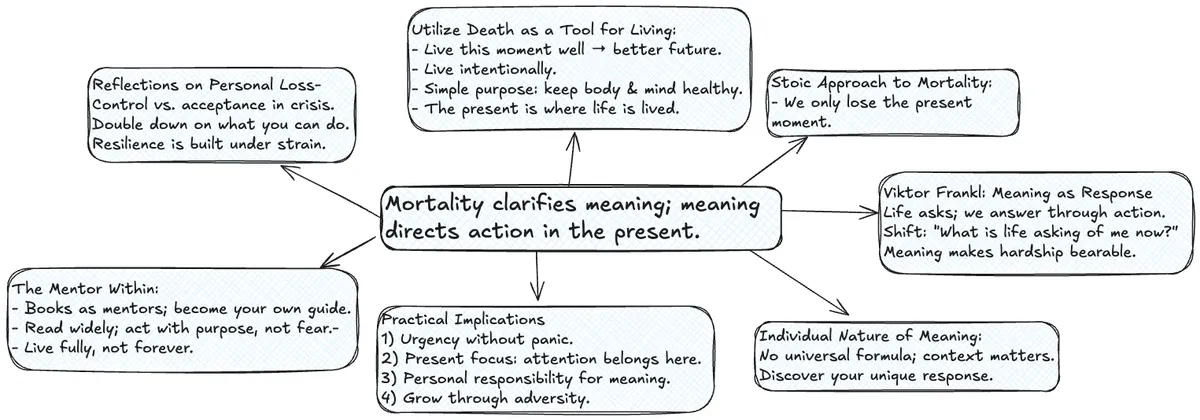
Reflections on Personal Loss
When my grandfather was in his final stages, I faced a choice that illustrated the Stoic principles we explored in chapter 1-of controlling what we can while accepting what we cannot. While family and villagers gathered around him, I closed my door for a job interview. This wasn’t callousness — it was practical wisdom. I couldn’t perform miracles for my grandfather, but I could prepare for our family’s financial future.
This experience taught me that when life knocks us down, instead of complaining or dwelling on uncontrollable circumstances, we must double down on the work that can lift us up. We must bring our best effort precisely when we feel at our worst. What doesn’t kill us truly makes us stronger, as it builds the resilience Marcus Aurelius championed.
The Stoic Approach to Mortality
Marcus Aurelius offers profound insight: we can only lose this moment — the present. Whether we die at 26 or 75, we lose nothing more or less. How can we lose something (the future) that we don’t possess, or the past that has already gone?
This perspective reveals that we are constantly dying and being reborn each moment. The past represents the “dead” version of ourselves. We live our whole lives “dead” if we don’t fully inhabit each present moment before it passes and becomes part of our history.
Finding Meaning Through Viktor Frankl’s Wisdom
Building on Stoic acceptance, Viktor Frankl, a Holocaust survivor and psychiatrist, offers crucial insight into life’s meaning. He argues that we shouldn’t seek the meaning of life; rather, life is asking us what our meaning is. Our job is to answer through our actions in every moment we are given.
This shifts the question from “What is the meaning of life?” to “What is life asking of me right now?” The answer lies not in abstract philosophy abstraction but in how we respond to our unique situations. We encounter.
Frankl observed: “Life is never made unbearable by circumstances but only by lack of meaning and purpose.” When we discover our personal meaning—our unique way of responding to challenges—we can endure almost anything.
The Individual Nature of Meaning
Since everyone faces different circumstances and moments, the meaning of life cannot be the same for everyone. It cannot be defined in universal terms or prescribed as a general formula. Each person must discover their unique response to life’s questions.
Beliefs, God, and Personal Truth
As we search for meaning, questions of belief — whether in God, religion, or other metaphysical concepts — often arise, creating tension between logic and conditioning. This conflict itself reveals how we construct meaning.
The Belief Paradox
Many people find themselves in the position where their logic says one thing (perhaps questioning God’s existence) but their emotional conditioning pulls them toward belief anyway. This isn’t weakness — it’s the natural result of deeply ingrained patterns.
A Practical Approach
Rather than debating God’s existence, consider this perspective:
- Even if God exists, you’re probably not so special that the universe revolves around your individual life.
- Things may simply be random, which means accepting what happens and making the best of it.
- This acceptance aligns with Stoic principles regardless of your religious beliefs.
Finding Meaning Without Certainty
You don’t need to resolve the God question to live meaningfully. Focus on:
- What you can control and influence.
- The positive impact you can have on others.
- The growth and learning available to you.
- The relationships and experiences that enrich your life.
Expanding Your Perspective
If you’re worried about humanity’s future or seeking divine intervention, you might be operating from a limited perspective. When you expand your view, you’ll find that godlike qualities exist in people around you — teachers, innovators, helpers, and leaders who dedicate their lives to making the world better.
This human-centred approach to meaning is both practical and empowering.
The Practical Conclusion
Whether God exists, your job remains the same: to live according to your values, contribute positively to the world, and make the most of the life you have. The meaning you create through your actions matters more than the metaphysical questions you can’t definitively answer.
Utilizing Death as a Tool for Better Living
Marcus Aurelius teaches us that future and past are not in our control — only the present moment. If we live this present moment better, we can make the future better too. But if we don’t live this present moment at our best, it passes and becomes part of our unlived past, essentially moving us closer to death without having truly lived.
Living Intentionally
Some people struggle daily with purpose or motivation. The simple solution is learning to live with questions, because you’ll never have answers to all questions in your entire lifetime.
Finding Purpose in Simplicity
If you’re struggling with purpose, consider this simple one: keep your body and mind healthy. Respect the vessel that allows you to think and act. Your body and mind are your real temple.
The Present Moment Focus
Live intentionally and live each moment to its fullest. In this way, life becomes preparation for death by living life to its fullest potential.
Practical Implications
Understanding mortality and meaning leads to several practical insights:
- Urgency without Panic: Knowing life is finite motivates action without creating anxiety.
- Present Focus: Since we can only lose the present moment, that’s where our attention belongs.
- Personal Responsibility: We cannot blame circumstances for our lack of meaning — we must create it.
- Growth Through Adversity: Difficult experiences often clarify what truly matters to us.
The Mentor Within
Having mentors is valuable, but ultimately, we must become our own guide. Through reading extensively - from Marcus Aurelius to modern thinkers - we can embrace wisdom from those we’ve never met. Books become conversations with the greatest minds in history.
The goal isn’t to live forever but to live fully in the time we have. When we accept mortality while embracing meaning, we free ourselves to act with purpose rather than paralyzed by existential anxiety.