 Musings with Randheer
The ancient wisdom of Stoicism, particularly through the writings of Marcus Aurelius in his “Meditations”, has profoundly shaped my approach to life. This philosophy offers practical tools for navigating modern challenges with ancient wisdom.
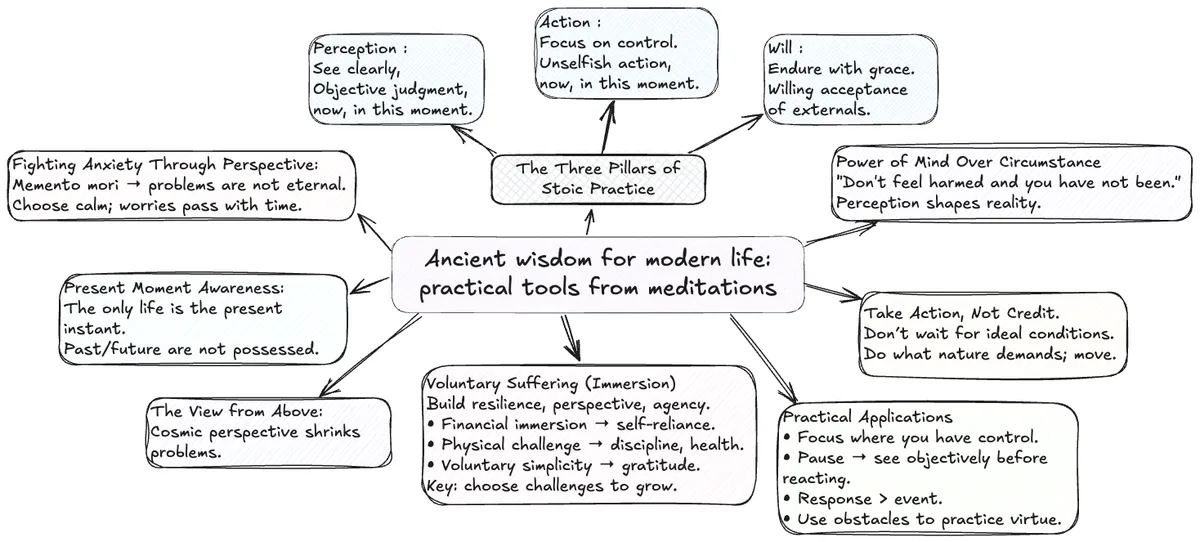
The first time I read Meditations by Marcus Aurelius, I was so excited that I told my grandfather that everyone above 18 must read it. This was not my first encounter with philosophy. I had even taken an elective course in college and had read many other books. However, this one felt direct, as if Marcus Aurelius were speaking directly to me. It has a profound impact on me and has helped shape the way I handle things now.
This was my first intro to stoic philosophy.
The Three Pillars of Stoic Practice
Perception, Action, Will - Marcus Aurelius outlined three fundamental principles:
- Perception: See things for what they are, not what you wish them to be. This means setting aside ego, bias, and belief to make objective judgments about reality. Marcus called this “objective judgment now, at this very moment.”
- Action: Do what you can with the things within your control, and don’t worry about things outside your influence. This translates to “unselfish action now, at this very moment.”
- Will: Endure and bear what you must with grace. Marcus described this as “willing acceptance - now, at this very moment - of all external events.”
When we follow these three principles, adversities can be transformed into advantages, and obstacles that seem to block our path can actually advance our progress.
Fighting Anxiety Through Perspective
Have you ever lain awake worrying about tomorrow’s problems? Marcus offers us a powerful technique for managing anxiety by contemplating mortality and impermanence. He reminds us that even doctors who cured thousands eventually fell ill and died, how those who predicted death for others eventually faced their own mortality, and how even great kings who destroyed cities and conquered empires ultimately departed this world.
This perspective reminds us that we are mortal beings. When we ourselves won’t live forever, why treat our problems as eternal? They, too, will pass. This understanding empowers us to choose happiness even in the face of adversity, recognising that our mental state - our freedom from negative stress and anxiety - remains within our control, regardless of what happens.
The Power of Mind Over Circumstance
One of the most liberating concepts from Stoicism is: “Don’t feel harmed and you have not been.” This refers to the power of our mind and feelings. We can choose not to feel harmed, and if we succeed in this choice, we genuinely are not harmed. The harm exists primarily in our perception and reaction to events.
Present Moment Awareness
Marcus reminds us: “You can’t lose another life than the one you are living now or live another one than the one you’re losing.” The longest life amounts to the same as the shortest because the present moment is identical for everyone. We can only lose this brief instant - the present - because we cannot lose what we don’t possess (the future) or what has already passed (the past).
Taking Action Without Seeking Credit
“Don’t await the perfection of Plato’s republic,” Marcus advises. Don’t wait for situations to be exactly as you want them. Accept reality as it is and begin moving. Do what nature demands of you, contribute what you can to improve things, and don’t worry whether anyone will give you credit for it.
The View from Above
This Stoic exercise involves imagining yourself from a cosmic perspective - seeing how small your problems appear when viewed from above. This helps us understand our place in the larger whole and can significantly reduce stress and anxiety about daily concerns.
Practical Applications
These ancient principles translate directly into modern life:
- When facing setbacks, ask: “What can I control in this situation?” Focus energy there.
- Before reacting emotionally, pause and try to see the situation objectively.
- Remember that your response to events matters more than the events themselves.
- Use challenges as opportunities to practice virtue and build character.
The beauty of Stoicism lies not in its complexity but in its practical simplicity. It offers a framework for living that has remained relevant for over two millennia because it addresses fundamental aspects of human experience that remain unchanged.
The Concept of Voluntary Suffering
Stoicism introduces the powerful concept of voluntary suffering — choosing to experience discomfort occasionally to gain perspective, avoid ego, and build resilience. In the corporate world, this translates to “immersion” - deliberately placing yourself in challenging situations to better understand problems you’re trying to solve.
Elon Musk embodies this: “When something is important enough to do, then you do it even if the odds are against you.”
Practical Applications of Voluntary Suffering:
- Financial Immersion: If you’ve always had financial support, voluntarily chose to live without it to understand self-reliance. This will build resilience and appreciation towards other struggle.
- Physical Challenge: Nobody enjoys exercise, but you choose to voluntarily suffer through it because you respect yourself and your body. This builds discipline and health.
- Poverty Awareness: Many people talk about poverty without ever experiencing financial constraint. Voluntary simplicity can provide genuine understanding of scarcity and gratitude for abundance.
The key insight is that voluntary suffering builds character and perspective that involuntary hardship cannot. By choosing your challenges, you maintain agency and learn more effectively - turning Stoic wisdom into unbreakable inner strength.