 Musings with Randheer
We live in an era of unprecedented change, where technological advancement outpaces our ability to learn and adapt. Understanding and preparing for this volatile future requires both practical skills and psychological resilience. This chapter looks at how to stay ready and positive amid these shifts.
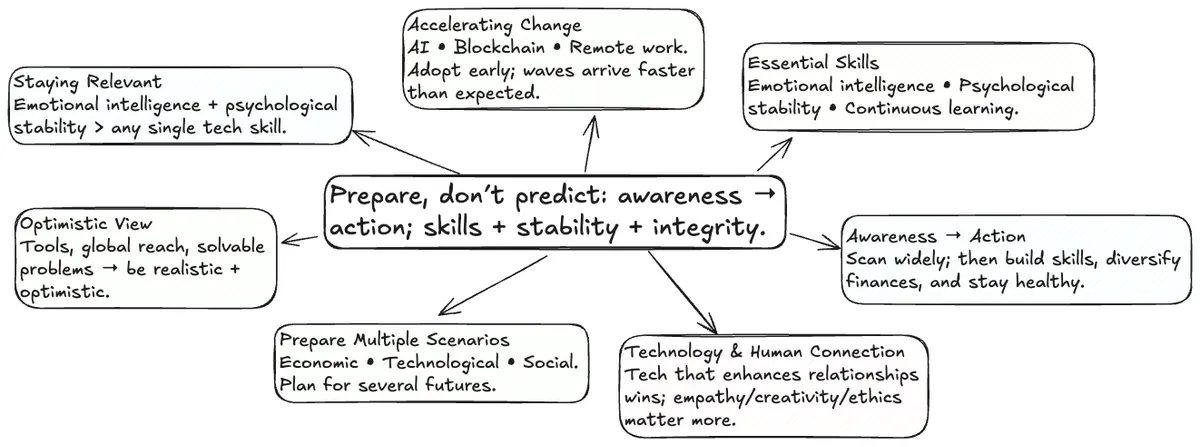
The Reality of Accelerating Change
The pace of technological change continues to accelerate exponentially. Consider the recent progression:
Artificial Intelligence: Just a few years ago, AI was primarily academic research. Now it’s transforming industries from software to healthcare, finance, and even creative work. Changing how we work on a daily basis.
Blockchain Technology: With AI, Blockchain Technology has also developed in parallel. It established itself across finance, supply chain, and governance applications.
Remote Work: The COVID-19 pandemic accelerated a decade of workplace evolution into a single year.
This pattern will continue — new technologies will emerge and mature faster than we expect, often while we’re focused on the previous wave of innovation. The key is to watch and adopt early.
The Challenge of Staying Relevant
Yuval Noah Harari identifies the core challenge in his book “21 Lessons for the 21st Century” the primary skills needed for the future are emotional intelligence and psychological stability.
These skills matter because:
- Unlearning and Relearning: You’ll need to change careers and acquire new skills at ages 35, 45, and beyond.
- Adaptation: The ability to adapt becomes more valuable than any specific technical skill.
- Resilience: Mental flexibility determines who thrives versus who gets left behind.
Government and Institutional Obsolescence
Matt Ridley and other thinkers suggest that by 2100, government as we know it may become obsolete. We can already see signs.
Technological Challenges to Traditional Authority:
- Cryptocurrencies challenge central banking.
- Decentralized platforms challenge content regulation.
- Global communication challenges national boundaries.
- Artificial intelligence challenges human decision-making roles.
Government Adaptation Struggles:
- Slow adoption of new technologies.
- Regulatory frameworks lagging behind innovation.
- Difficulty governing global, decentralized systems.
This doesn’t necessarily mean chaos, but rather evolution toward new forms of organization and governance.
The Volatility of Our Times
Recent events demonstrated how quickly our world could change:
- Germany implemented strict lockdowns during COVID-19 despite its confidence compared to any other country in having control over the situation.
- Supply chain disruptions affecting global commerce.
- Geopolitical tensions reshaping international relationships.
This volatility requires a new mindset: preparation and awareness rather than prediction. Focus on what can you do today to handle surprises tomorrow.
Essential Skills for an Uncertain Future
Emotional Intelligence: The ability to:
- Manage your own emotions during uncertainty.
- Understand and work with others effectively.
- Adapt to changing social and work environments.
- Maintain relationships across cultural and technological divides.
Psychological Stability: The capacity to:
- Handle ambiguity and uncertainty.
- Learn new skills throughout your lifetime.
- Maintain identity while changing careers.
- Stay grounded during rapid external change.
Continuous Learning: The habit of:
- Reading widely across disciplines.
- Experimenting with new technologies.
- Seeking out different perspectives.
- Updating your mental models regularly.
The Awareness-Action Framework
The most important preparation for an uncertain future is awareness followed by action based on that awareness.
Staying Aware:
- Keep your eyes and ears open to changes around you.
- Read beyond your immediate field of interest.
- Pay attention to emerging technologies and trends.
- Notice how different industries and countries are adapting.
Taking Action:
- Develop skills that are likely to remain valuable (creativity, critical thinking, emotional intelligence).
- Build financial resilience through diversified investments and multiple income streams.
- Maintain physical and mental health as your foundation.
Technology and Human Connection
As technology advances, human connection becomes more valuable, not less. The technologies that succeed will be those that enhance rather than replace human relationships.
This means:
- Social Skills become more significant, not less.
- Empathy and Understanding differentiate humans from machines.
- Creative Problem-Solving remains uniquely human.
- Ethical Decision-Making becomes crucial as technology’s power grows.
Preparing for Multiple Scenarios
Since we cannot predict exactly how the future will unfold, prepare for multiple possibilities.
Economic Scenarios:
- Traditional employment continuing
- Gig economy expansion
- Universal basic income implementation
- Major economic restructuring
Technological Scenarios:
- AI augmenting human work.
- AI replacing many job categories.
- New technologies creating entirely new industries.
- Decentralized systems replacing centralized ones.
Social Scenarios:
- Increased global cooperation.
- Fragmentation into smaller communities.
- New forms of governance and organization.
- Greater individual autonomy and responsibility.
The Indian Education System Challenge
India’s education system exemplifies the broader challenge of preparing for the future. Current ed-tech solutions often miss the real problem by focusing on symptoms rather than root causes.
The Real Problem
Most ed-tech startups focus on NCERT content and CBSE curriculum, but these are primarily accessible to families who can afford expensive English-medium schools. The real challenge is that quality primary education is financially out of reach for most Indian families.
Economic Reality:
- CBSE schools typically charge Rs.1,000+ per month, even for primary classes.
- Families earning Rs.8,000 - Rs.25,000 per month cannot afford these fees and this represents 90% or more population of India.
- Government schools in most states provide inadequate education.
- This creates a system where economic circumstances determine educational opportunities from the start.
The Misdirected Solution
Current ed-tech solutions build on the existing system rather than replacing it. They help students who already have access to good schools but don’t address the fundamental accessibility problem.
What’s needed
Instead of adding layers to an already expensive system, we need solutions that:
- Provide quality education regardless of economic background.
- Replace rather than supplement expensive private schooling.
- Address the root cause rather than treating symptoms.
- Create genuine equality of opportunity.
The Broader Lesson
When addressing any systemic problem, always ask: “Are we solving the real problem, or are we building solutions that require the problem to continue existing?” True innovation often requires replacing broken systems rather than optimizing them.
The Digital Divide Reality
Having unlimited high-speed internet is a significant advantage when only 56% of India’s population has internet access. This digital divide creates social divisions, keeping those without access away from new world opportunities.
COVID-19’s Impact
The pandemic worsened this divide. Many students permanently left school because institutions couldn’t provide online learning or families couldn’t afford both internet packages and school fees.
The Asymmetric World
Our world operates asymmetrically, favouring those already privileged. More than 90% of Indians earn less than Rs.25,000 monthly, making survival — not growth — their primary concern.
Personal Application
In your own career and life planning
- Identify root causes rather than symptoms.
- Build skills that don’t depend on broken systems.
- Create value that serves underserved populations.
- Think systemically about the problems you want to solve.
Government Job Protest and Alternative Thinking
It’s concerning to see youth protesting for government jobs that represent only 2-3% of total employment (and decreasing). I’m not saying protesting is right or wrong. If something is systematically being done wrongly and nobody is listening to you to fix it, then maybe that is the only thing could be thought of to make your voice heard. But if the same energy spent preparing for competitive exams over 3–4 years were directed toward skill development, these individuals could earn significantly more than government employees. This is just a perspective, individual is free to have their own perspective to go where ever they wish, but if everything should have some deadline in my perspective. The same goes with government job, I feel you should not be giving in prep full-time more than 2 years of your prime time at least. You may keep trying writing exam after three years while doing something else. But not just full-time prep and doing nothing.
Common Obstacles:
- Status Association: Government jobs carry social prestige, but this is a “mindset disease” of caring too much about others’ opinions.
- English Barrier: Many avoid corporate paths due to English language concerns — solvable with 6 months of dedicated effort.
- Security Illusion: Government jobs seem secure, but COVID-19 showed even government employees faced pay cuts.
Better Alternatives:
- Develop marketable skills over 3–4 years instead of preparing for exams.
- Learn to invest money systematically (like government PPF deductions).
- Build multiple income streams.
- Focus on inner scorecard rather than social validation.
The future belongs to those who adapt and build valuable skills, not those waiting for traditional “secure” positions that may not exist.
The Long-Term Perspective:
While change is accelerating, human nature remains relatively constant. The fundamentals that have always mattered still matter:
- Character and Integrity: Trust remains the foundation of all relationships.
- Health and Fitness: Physical and mental well-being enable everything else.
- Learning and Growth: The ability to adapt has always been crucial for survival.
- Relationships: Human connections provide meaning and support.
- Purpose and Meaning: People need reasons to get up in the morning.
Practical Preparation Steps
Financial:
- Diversify investments across asset classes and geographies.
- Develop multiple income streams.
- Build emergency funds for an extended period of time.
- Understand both traditional and emerging financial systems.
Professional:
- Develop skills that complement rather than compete with technology.
- Create a personal brand that transcends any single employer.
- Stay updated with developments in your field and adjacent fields.
Personal:
- Maintain physical and mental health as your foundation.
- Develop emotional resilience and stress management skills.
- Cultivate relationships that provide support and perspective.
- Keep learning new things to maintain mental flexibility.
The Optimistic View
Despite the challenges, this era of change also offers unprecedented opportunities:
- Access to information and education for everyone.
- Ability to connect and collaborate globally.
- Tools to solve problems that have plagued humanity for centuries.
- Potential for increased prosperity and human flourishing.
The key is to remain optimistic while being realistic about the challenges ahead. Prepare for difficulty while staying open to possibility.
Remember: The future belongs to those who can adapt, learn, and maintain their humanity in an increasingly technological world. The goal isn’t to predict the future perfectly but to build the capabilities that will serve you regardless of how it unfolds.